works @ I.I.I.
Jaurès - Plateau Urbain
182-186 boulevard de la Villette
75019, Paris
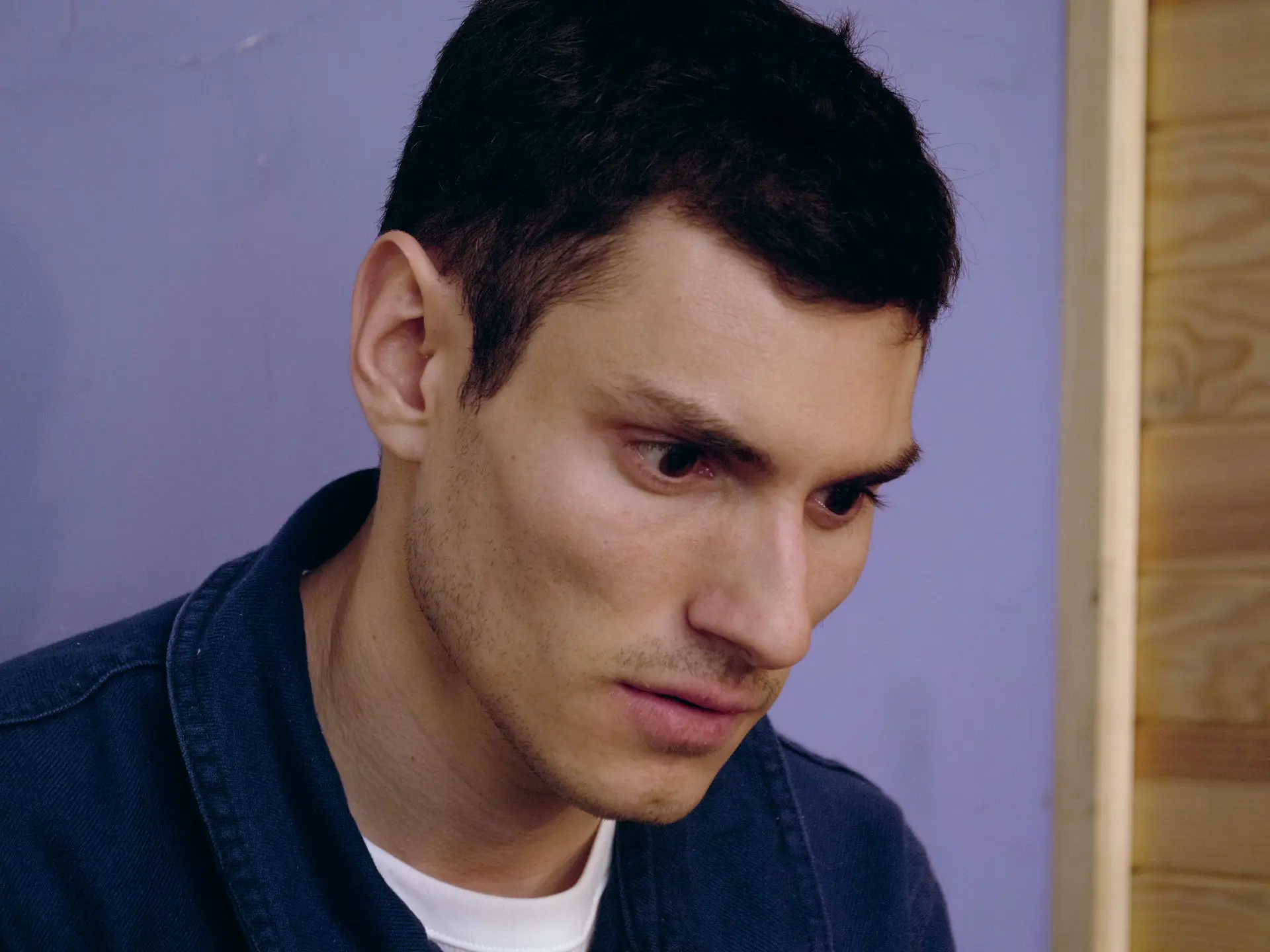
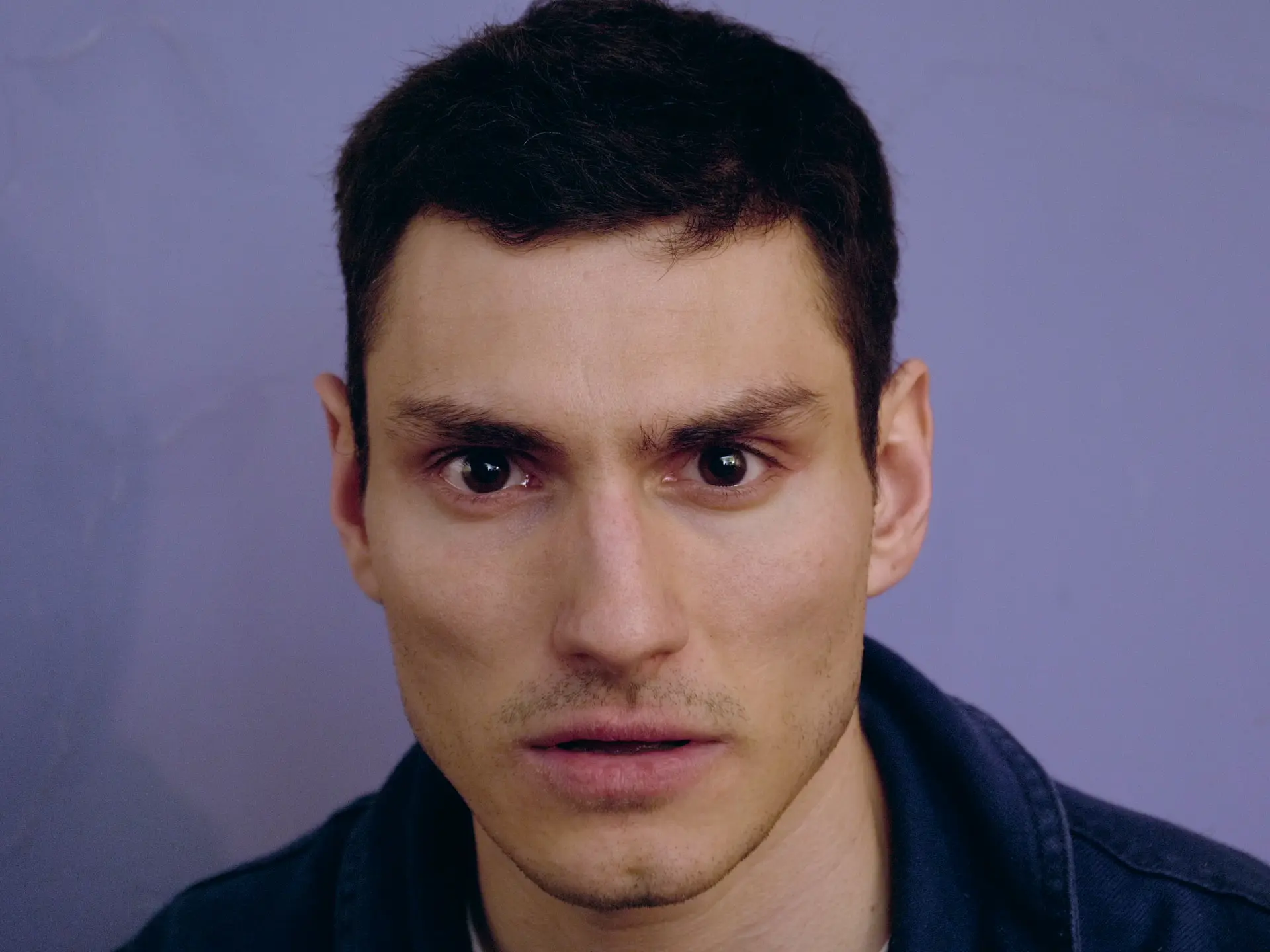
My work takes as its starting point systems of simulation: institutional, economic, managerial, technological apparatuses that have internalised their own logic to the point of closing in on themselves. These environments are not metaphors: they are existing, documentable forms in which bodies continue to move as if something were still at stake.
What interests me is not the critique of these systems, but the question of what the body produces when it finds itself caught within an exhausted apparatus. How it generates meaning where meaning has withdrawn. How it invents a gestural, postural, verbal language from that very deprivation.
This movement — finding a trajectory from within a closed system — also determines the way I make films. I enter subjects through immersion, making myself available to coincidences, accidents, unforeseen encounters. The filmmaking situation itself becomes a space where something can shift: the people filmed tell themselves differently, the documentary slides toward fiction, the body invents a language that discourse had not anticipated.
synopsis
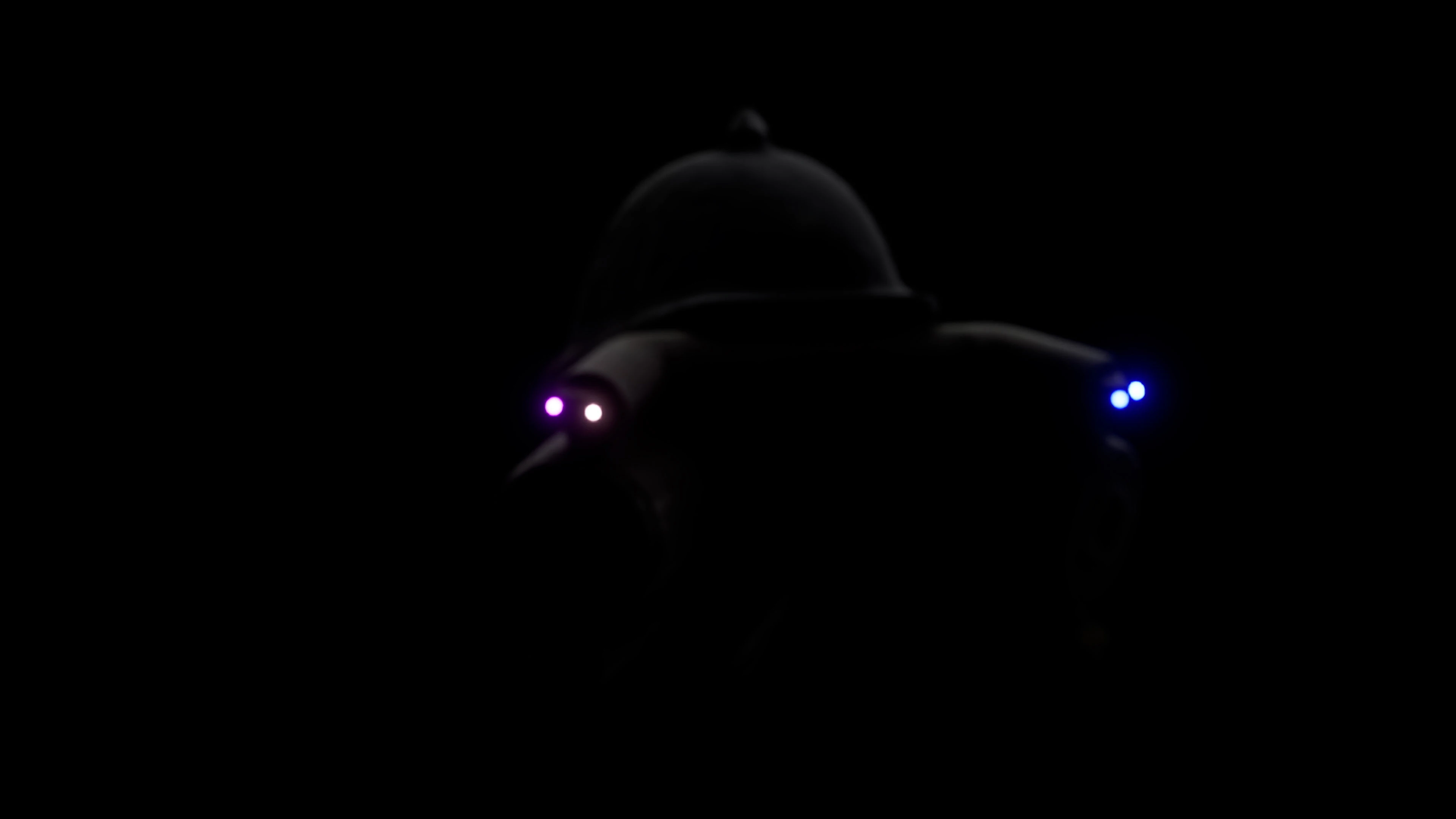
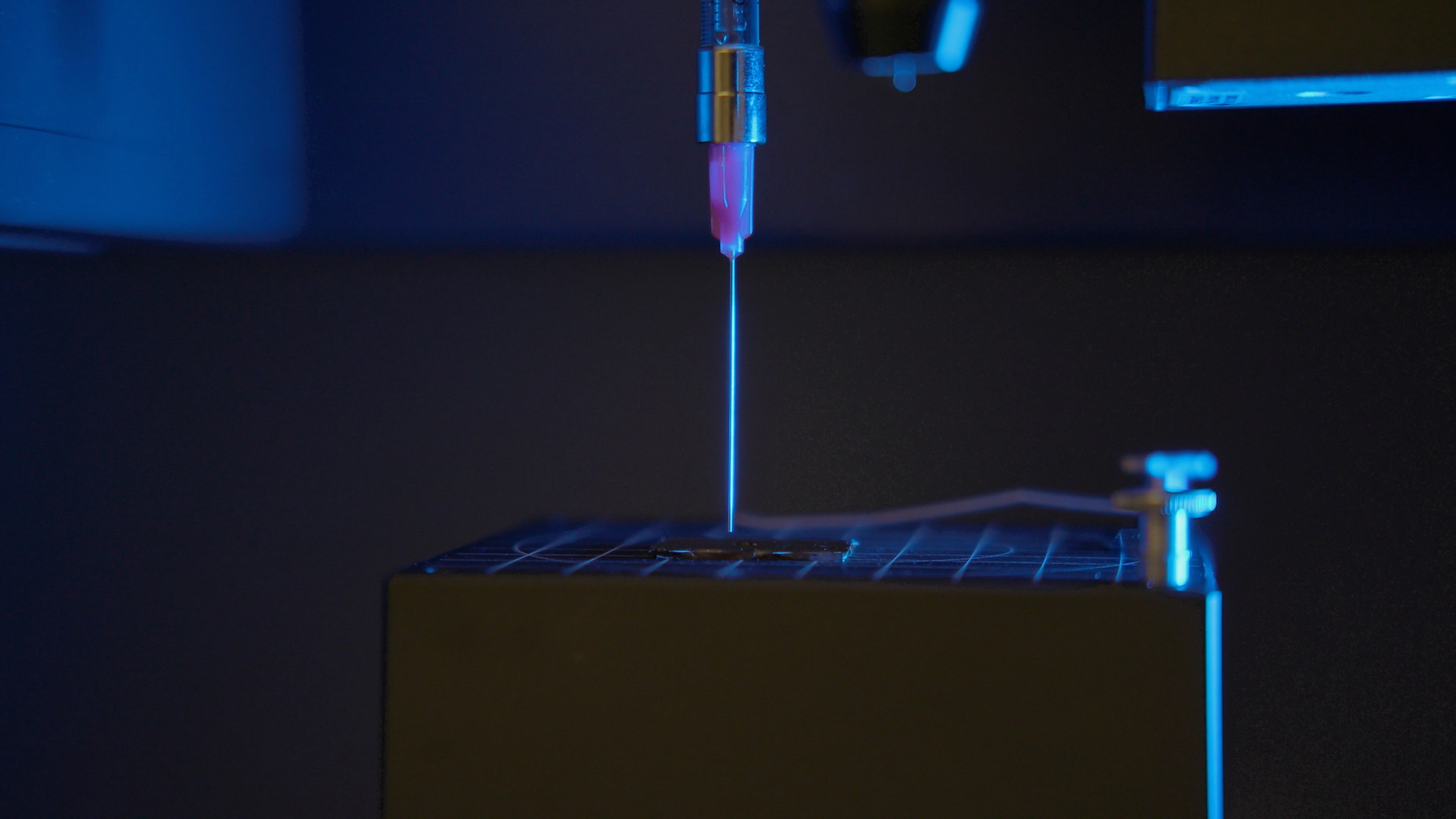
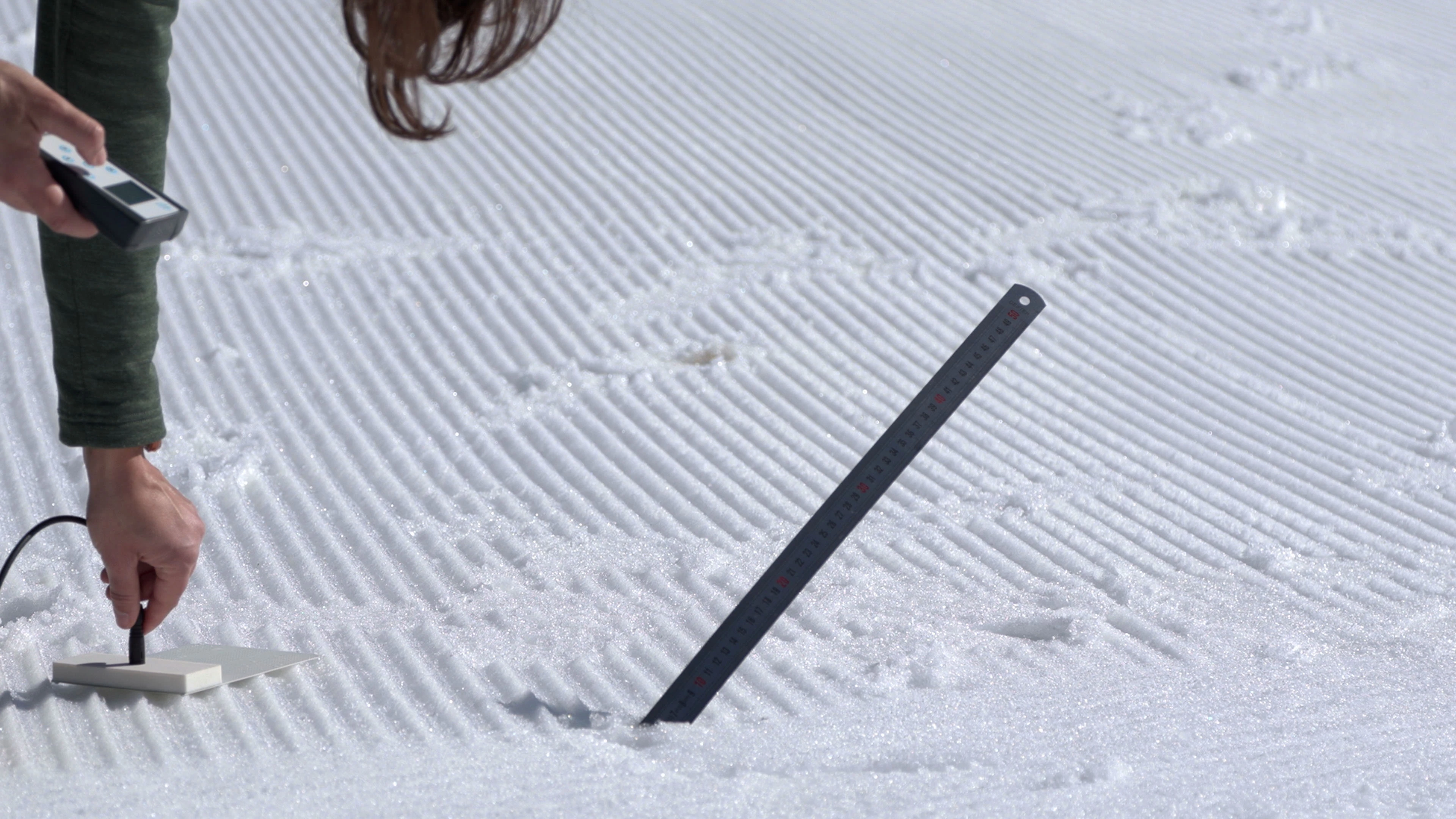
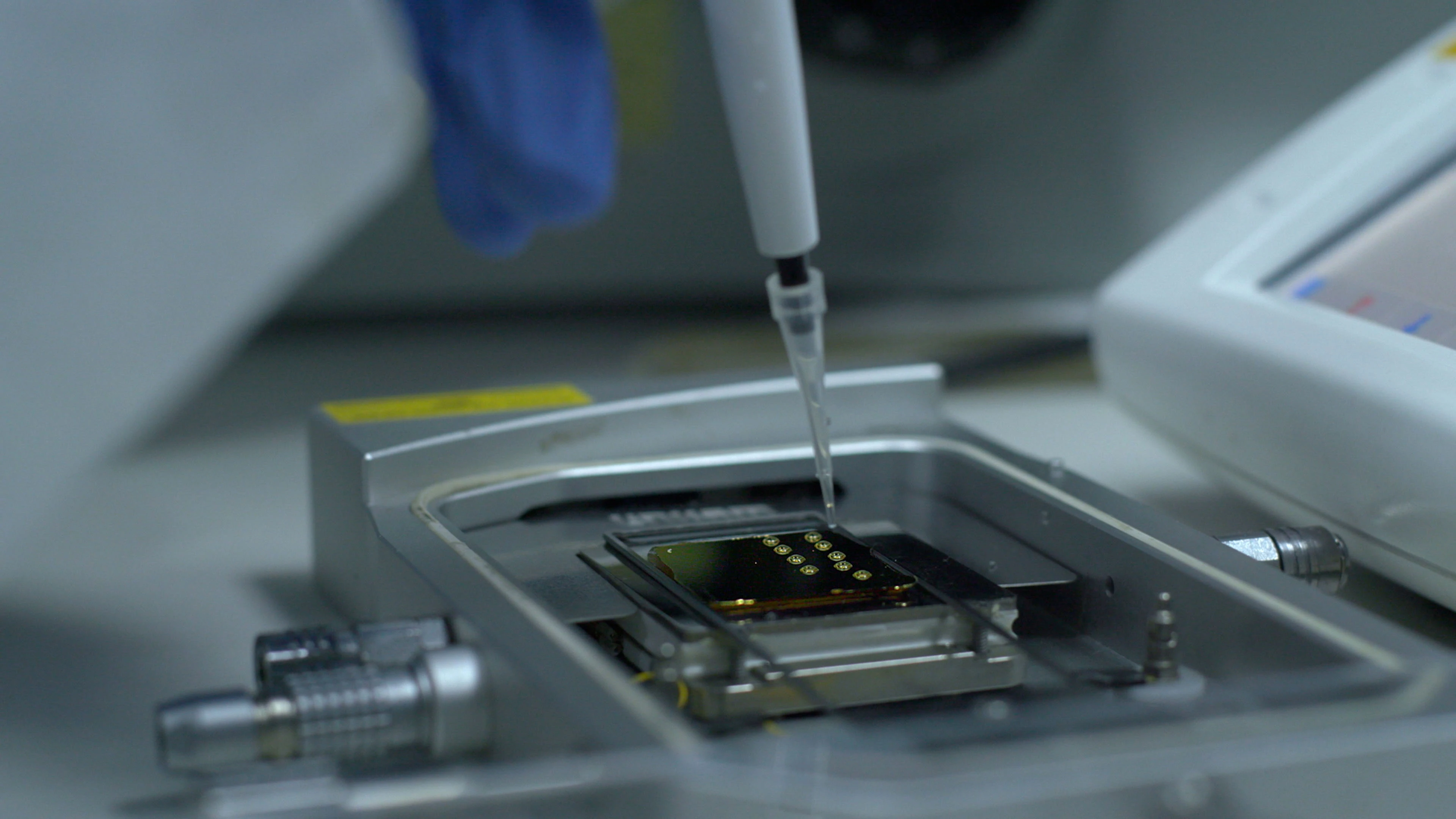
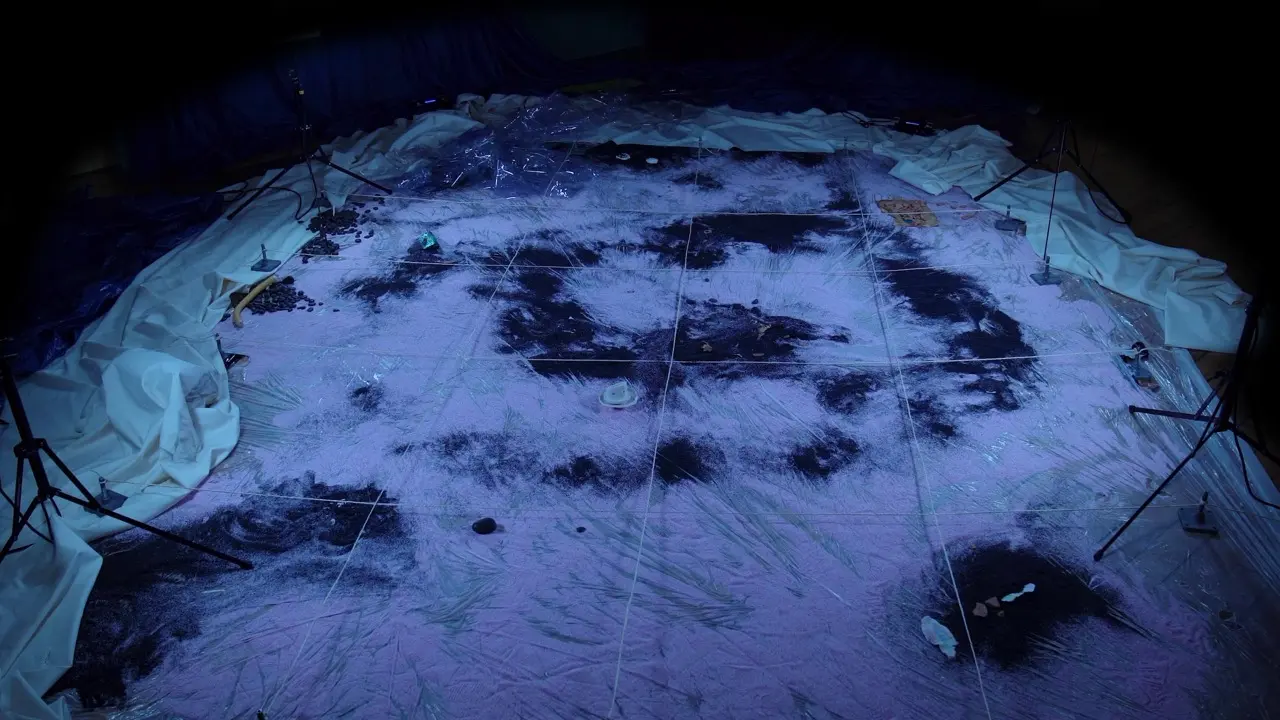
Snowgun heads come to life and share their anxieties and certainties, while the substance they expel night after night radically transforms the mountain landscape. Miracle technology, divine power, magic trick? At the heart of this industrial process, the manufacture of premium white promises resurrections, operates in the invisible, and is perfected in scientific laboratories.
description
Snow has disappeared. It will still fall here and there, sometimes in abundance, but as a phenomenon structuring an economy, it no longer exists. It has been replaced by an artefact: the Product. Its technique is invisible, its aura is magical. The question is no longer about envisioning the future disappearance of snow, but about questioning the persistence of its representation, which, in our collective imagination, still survives. Snow still appears to us as immaculate, pure, natural.
My documentary approach takes the form of a portrait of artificial snow. A techno-magical entity, with no image of its own. I wanted to film it in its most trivial materiality: as factory-made merchandise, optimised in a laboratory, routed through complex networks. An expensive product, dependent on considerable resources, specific conditions, and an ideology of control. I also wanted to narrate its mystification: to describe the cognitive and symbolic mechanisms that sustain the illusion of its naturalness.
Three filmmaking materials interweave: the production of the product at a ski resort in the Pyrenees, its optimisation in a Barcelona laboratory, and its experimental embodiment through 3D models created from snowgun heads (photogrammetry).
short film
Tu es la pluie dans ma sécheresse
Documentary
1920×1080, 16:9
24
2024
Centre Pompidou
still, Tu es la pluie dans ma sécheresse, 1920×1080
still, Tu es la pluie dans ma sécheresse, 1920×1080
still, Tu es la pluie dans ma sécheresse, 1920×1080
still, Tu es la pluie dans ma sécheresse, 1920×1080
still, Tu es la pluie dans ma sécheresse, 1920×1080
still, Tu es la pluie dans ma sécheresse, 1920×1080
1 / 8
description
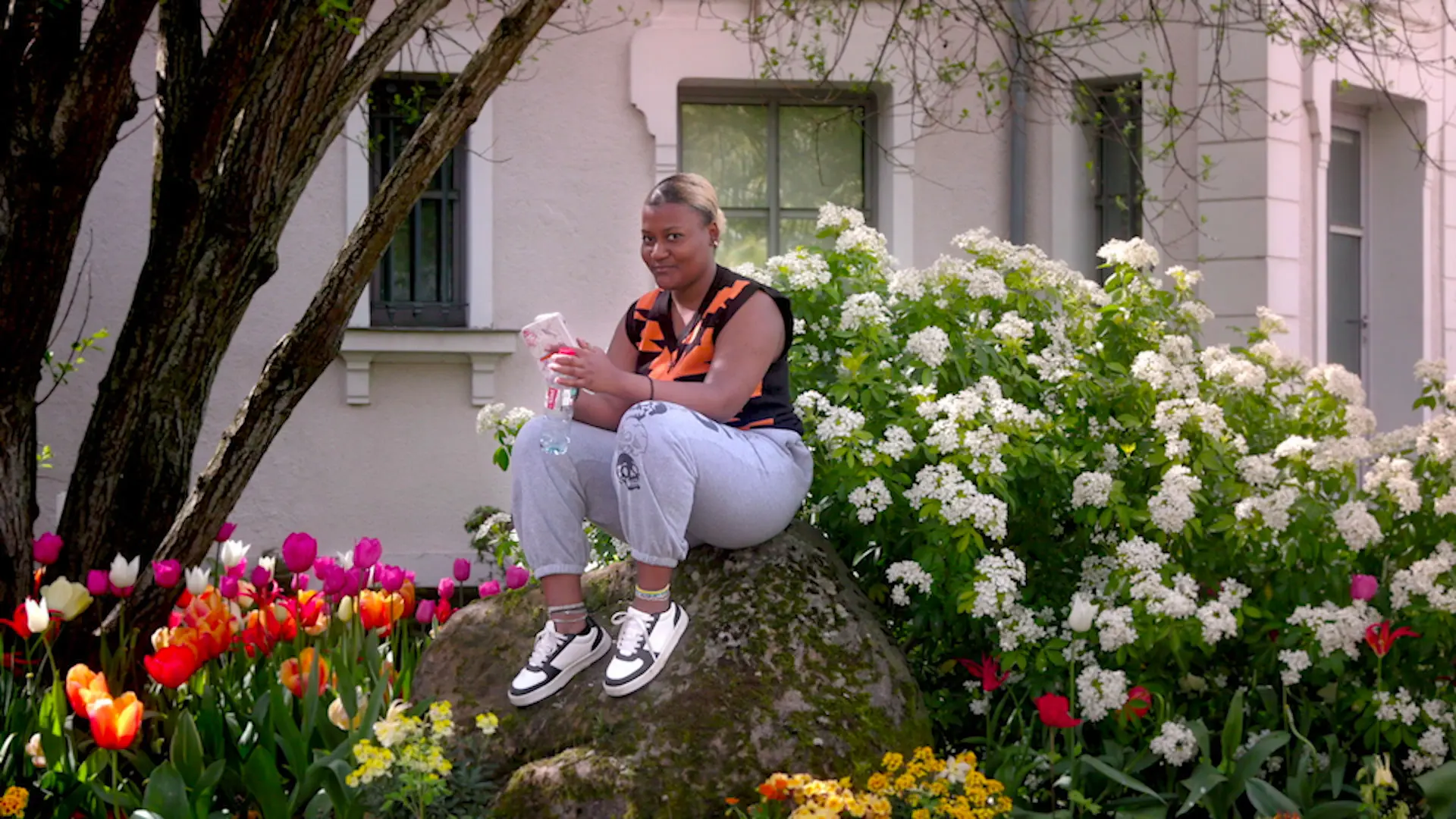
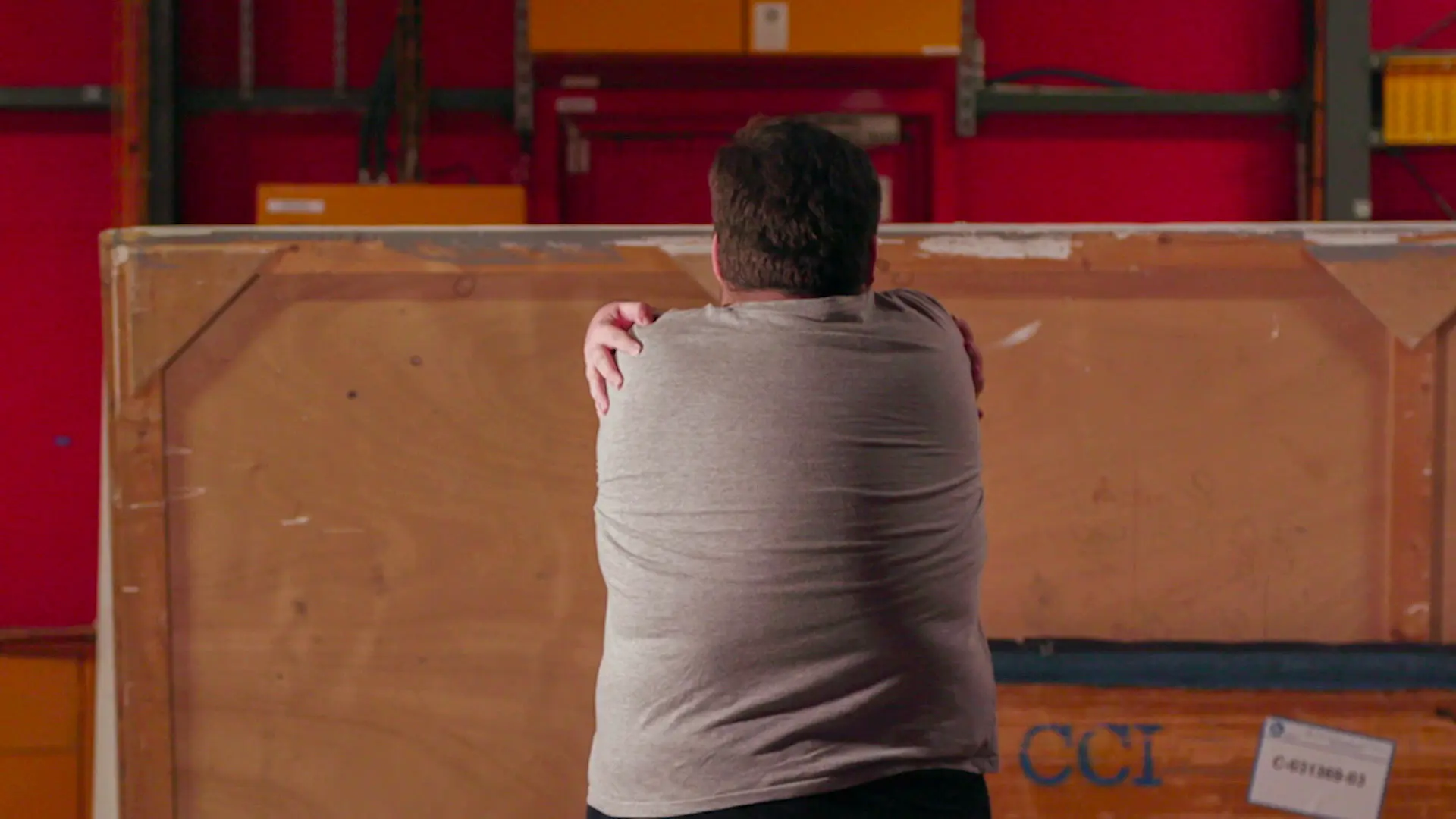
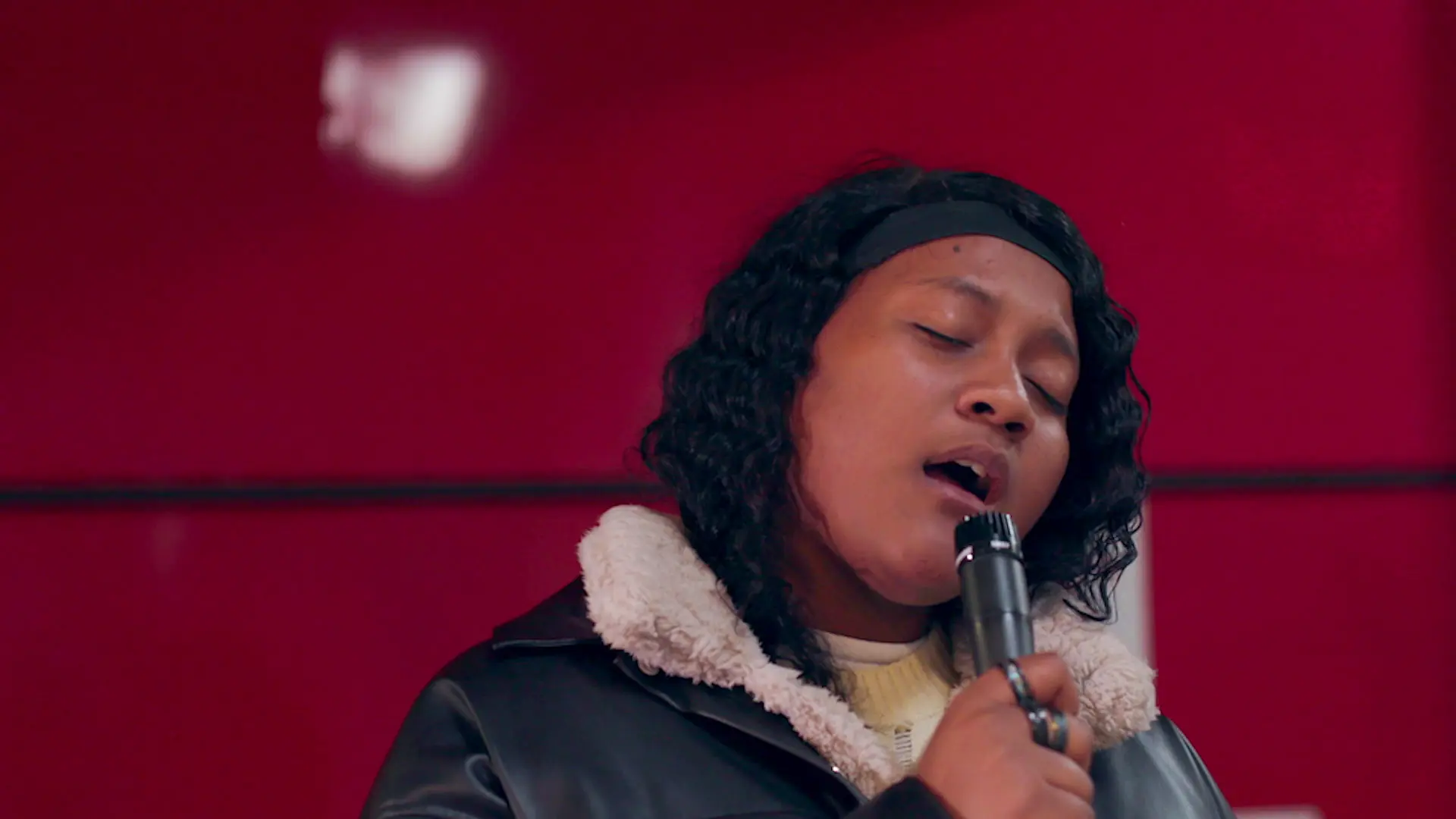
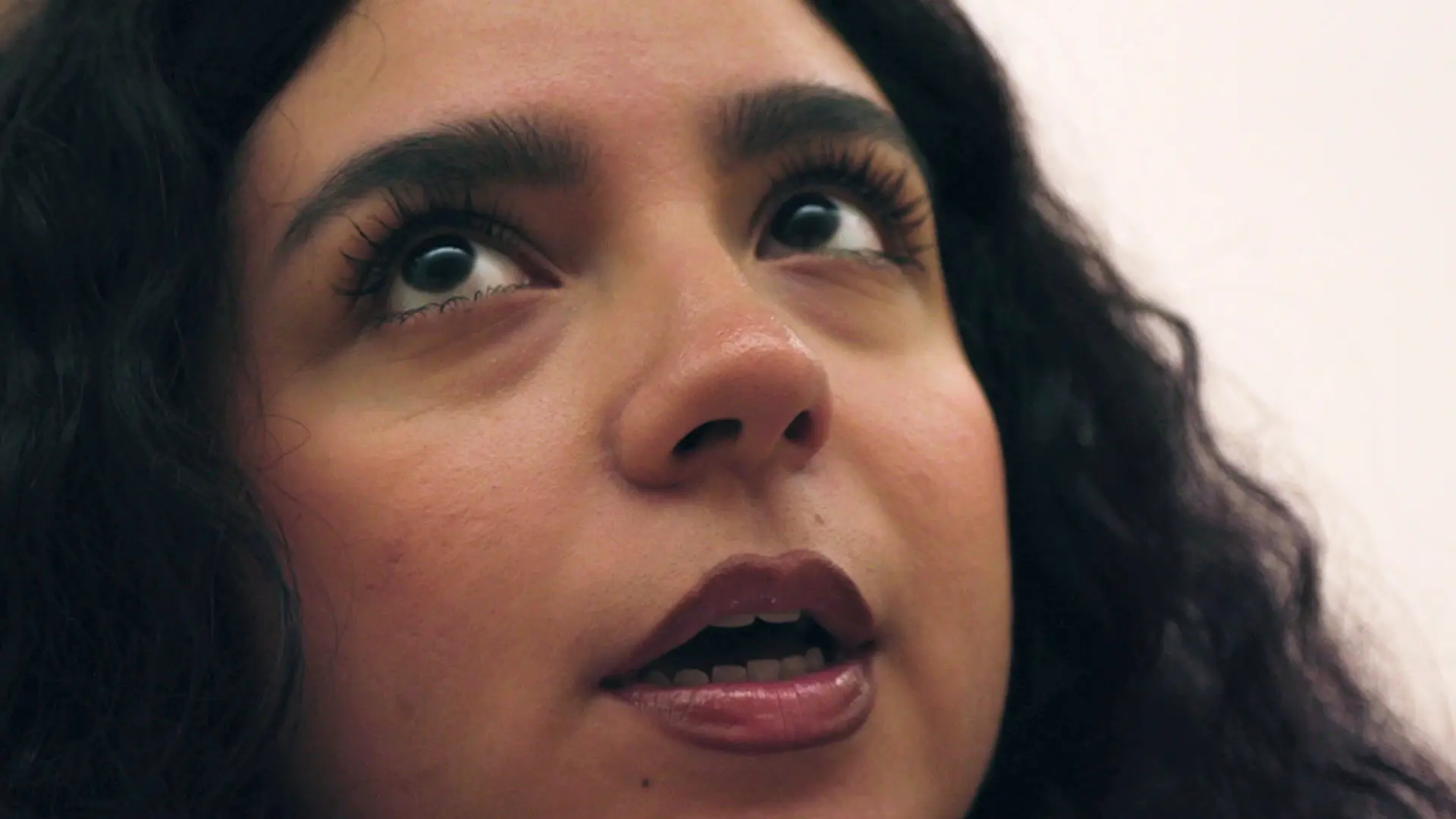
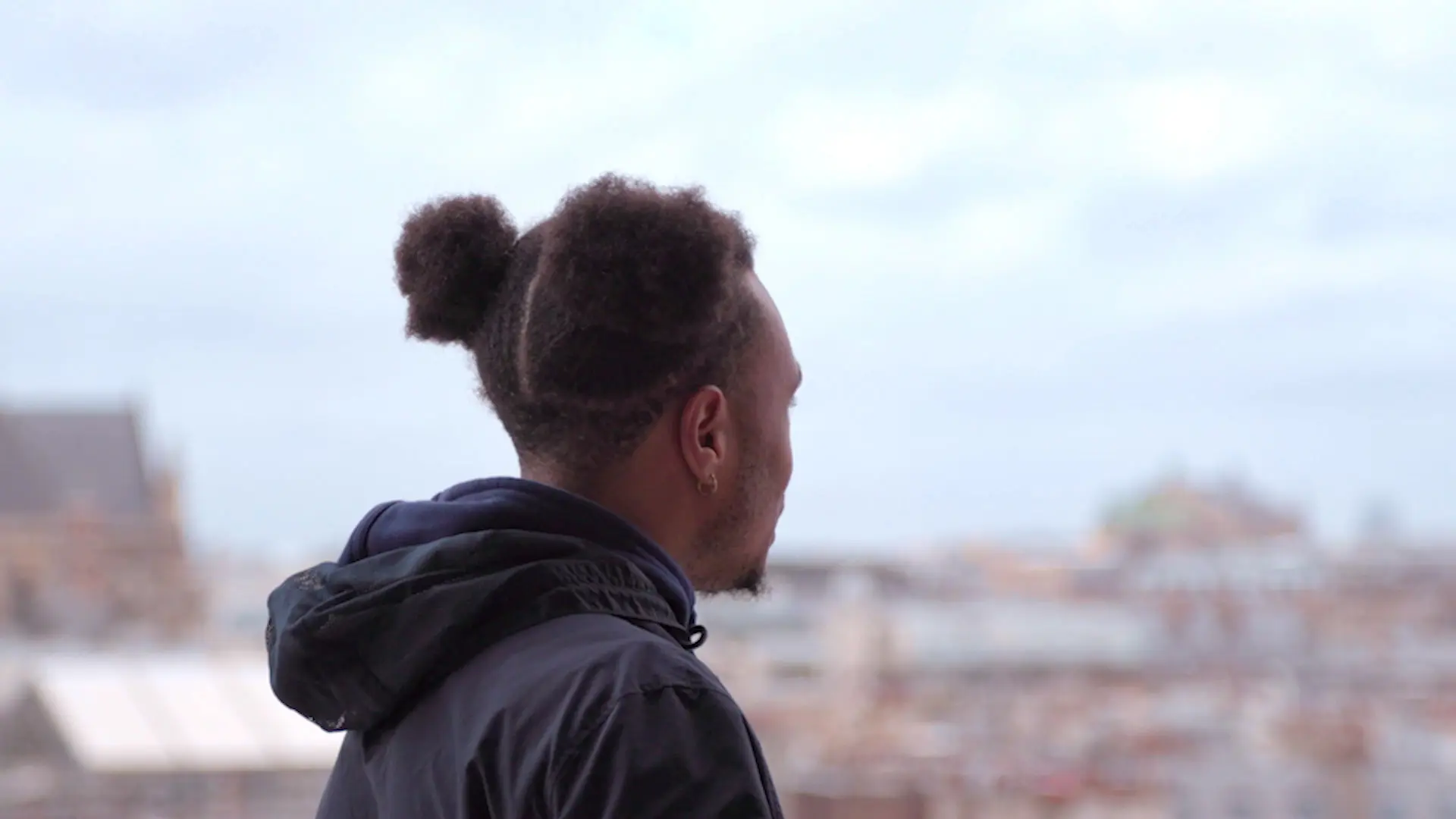
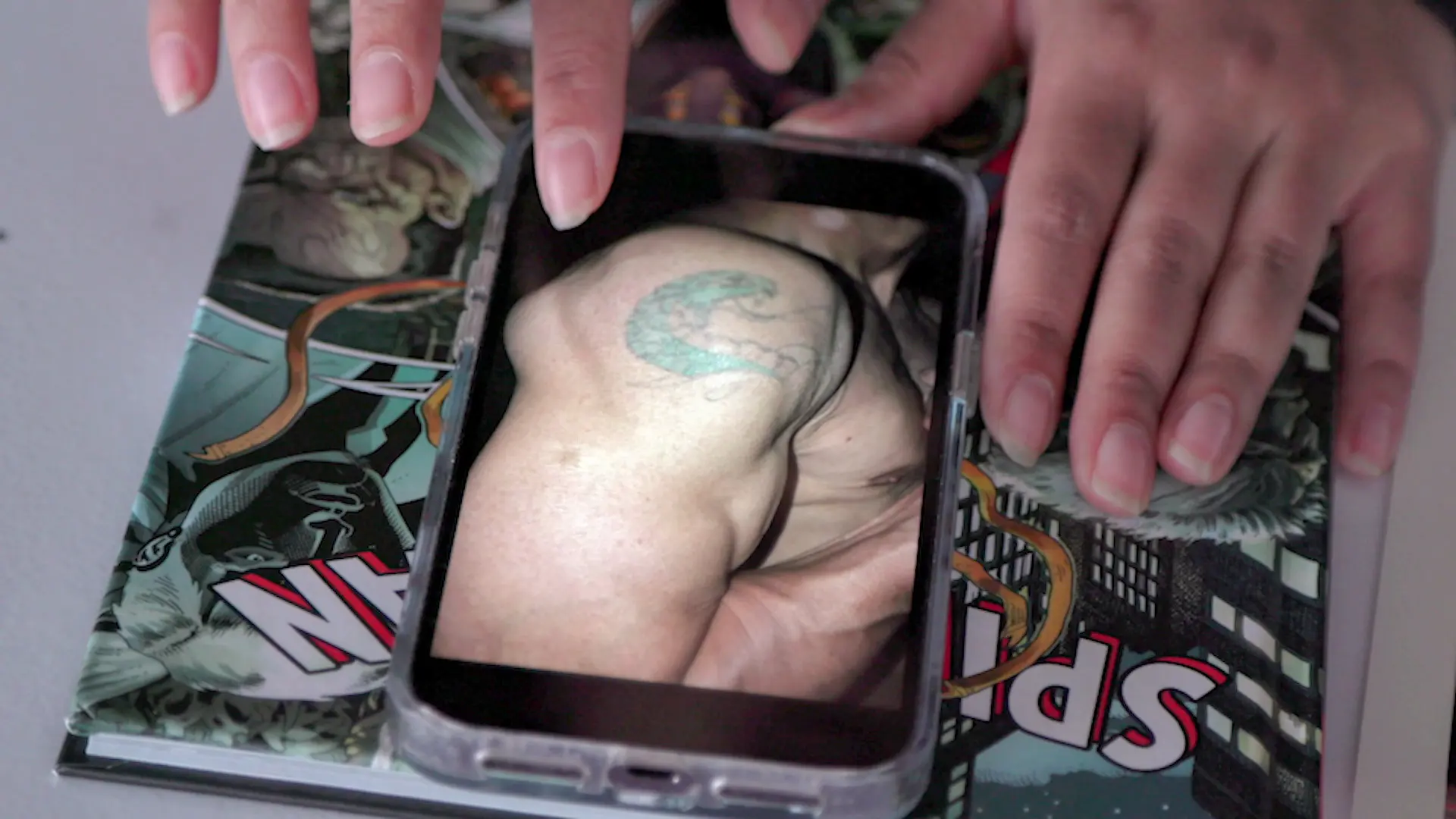
Magalie, Maunie, Sylvana, Charlay, Matthias, Émilie, Vladimir, and Saskia live in Evry-Courcouronnes and Ris-Orangis.
They are all between 18 and 25 years old and are engaged in processes of professional reintegration or reorientation.
They participated in the Escales 2024 programme.
This programme, funded by the Île-de-France regional prefecture, invited them to imagine, devise, and perform a piece inspired by a work of their choice from the Centre Pompidou's permanent collection. The Centre offered them a range of preparatory activities: theatre coaching, museum visits, parkour, etc. These regular sessions formed the context of our encounters.
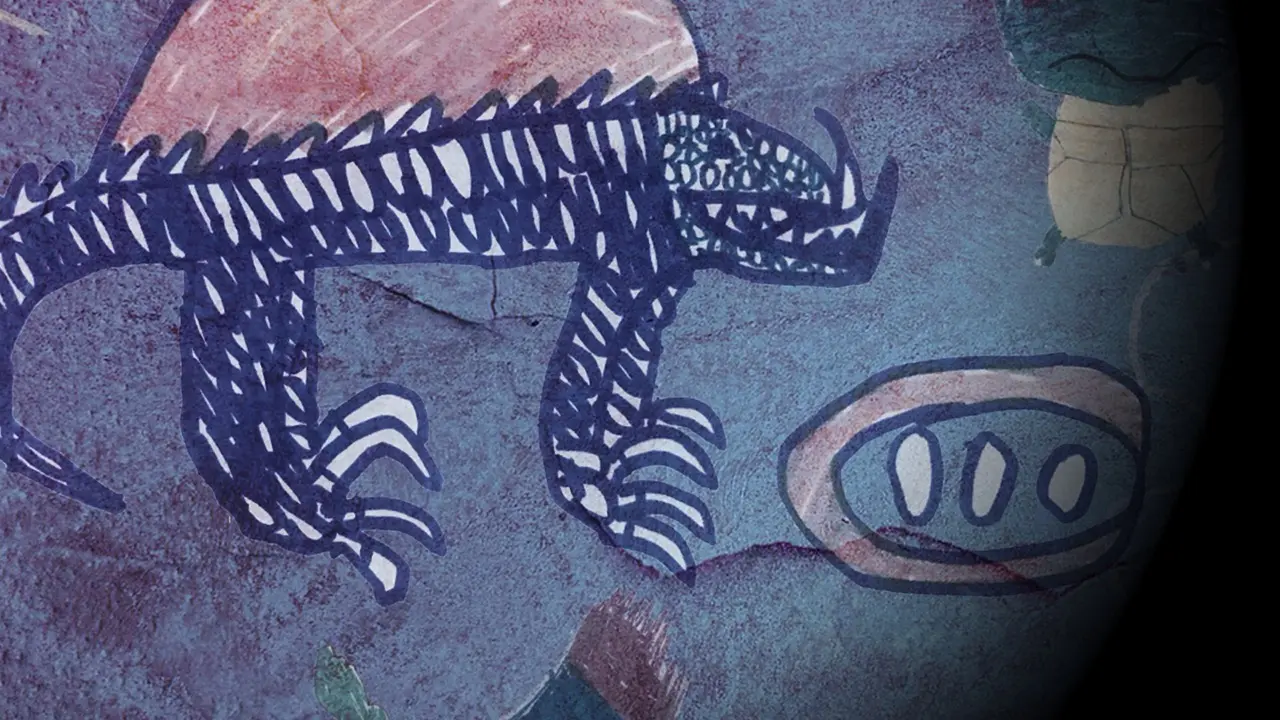
description Culture(s) de demain
is an arts education programme for children aged 8 to 12, led by ADAGP in partnership with LE BAL and La Source.
Each year, it invites artists to lead creative workshops in schools around a shared theme (such as "Les pieds sur terre"),
encouraging pupils to observe, question and transform their environment. The project concludes with a collective presentation.
synopsis
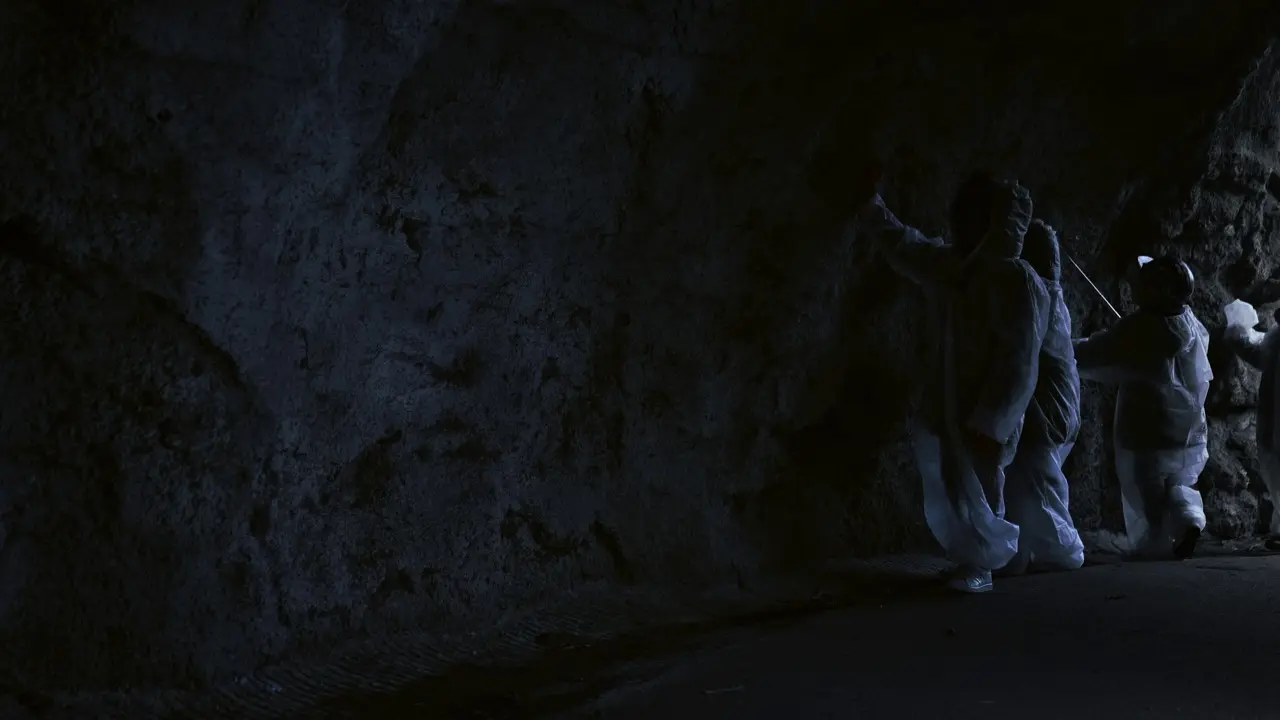
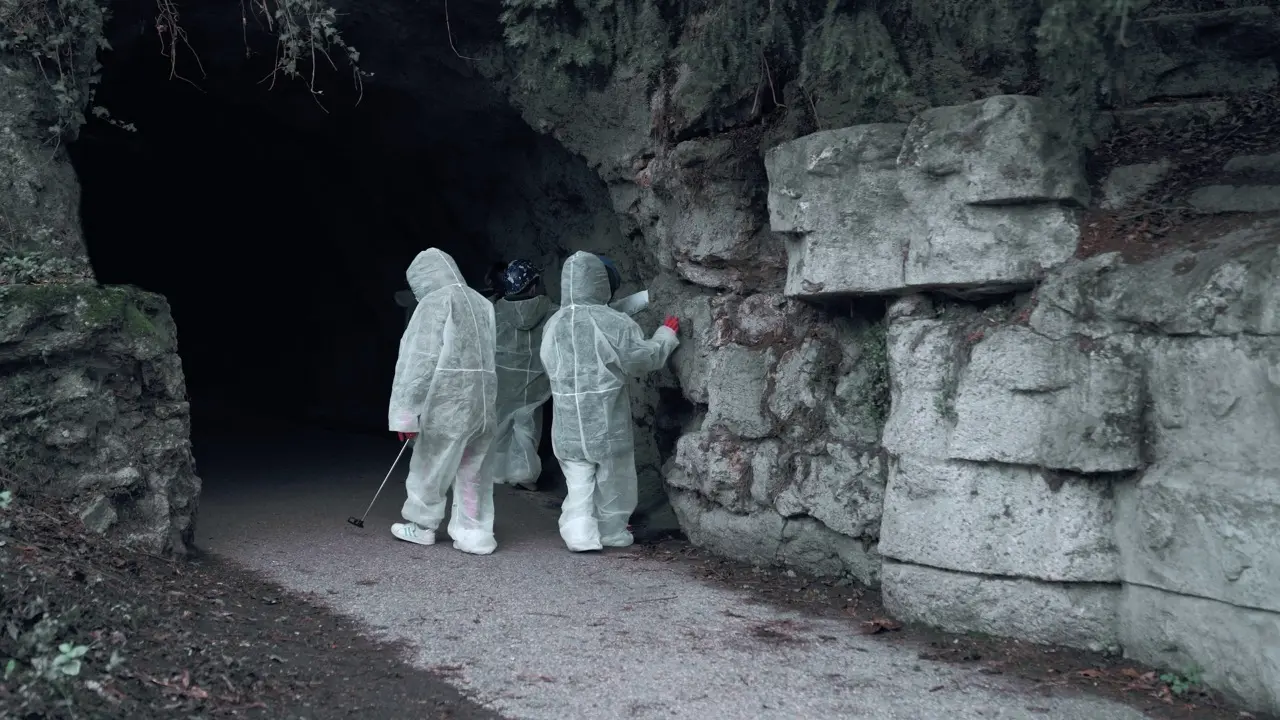
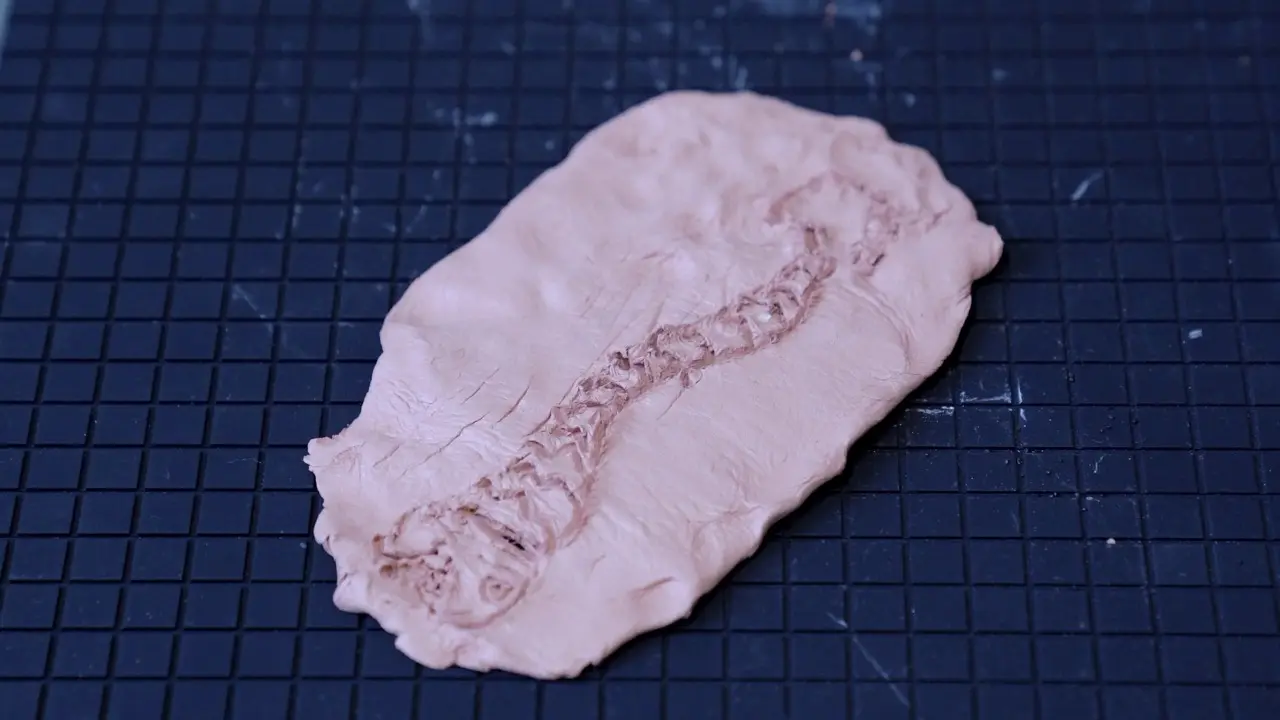
In 8432, a group of archaeologists discovers a buried cave in what appears to have been an urban metropolis. With it, a trace of human presence which, through carbon-14 dating, places this civilisation around 2023. Between hybrid objects and fantastical beliefs, what do these traces and artefacts from the past say about their era? And what will this discovery unleash for the group of researchers?
synopsis
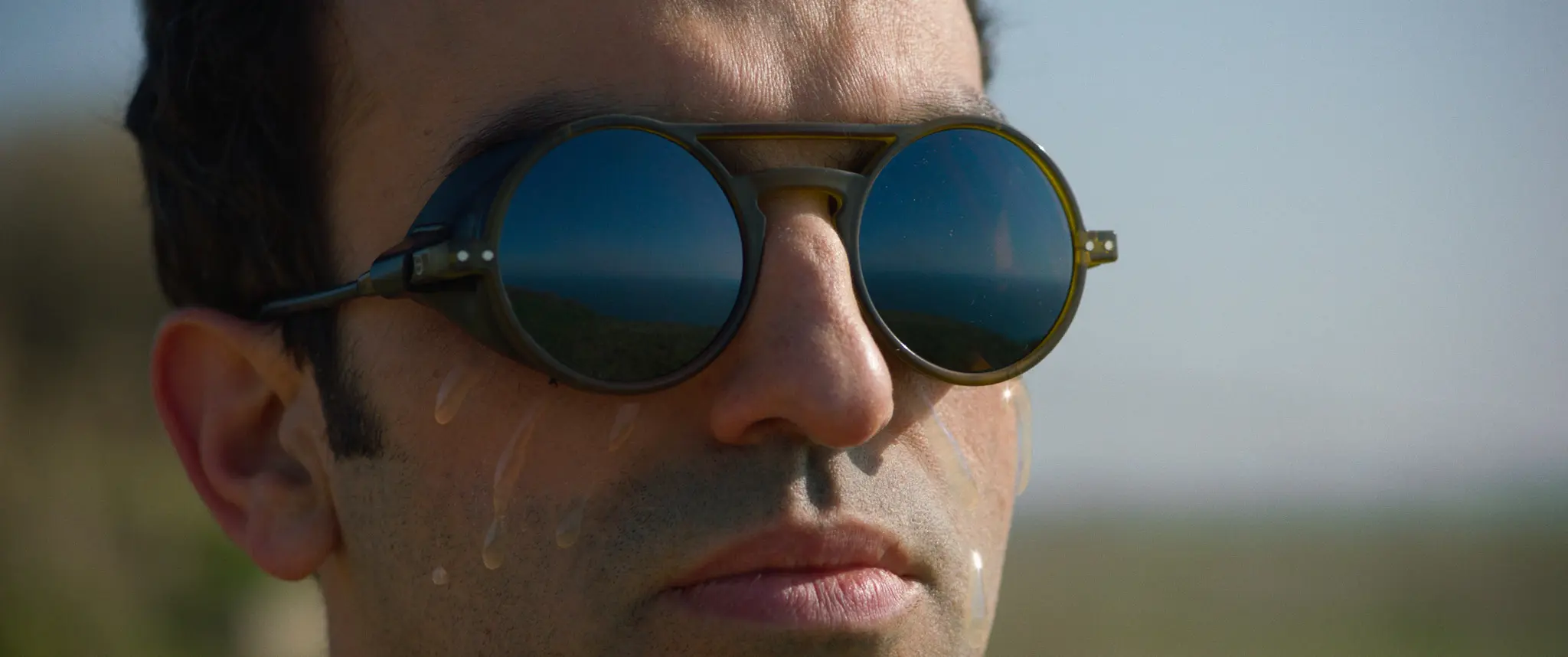
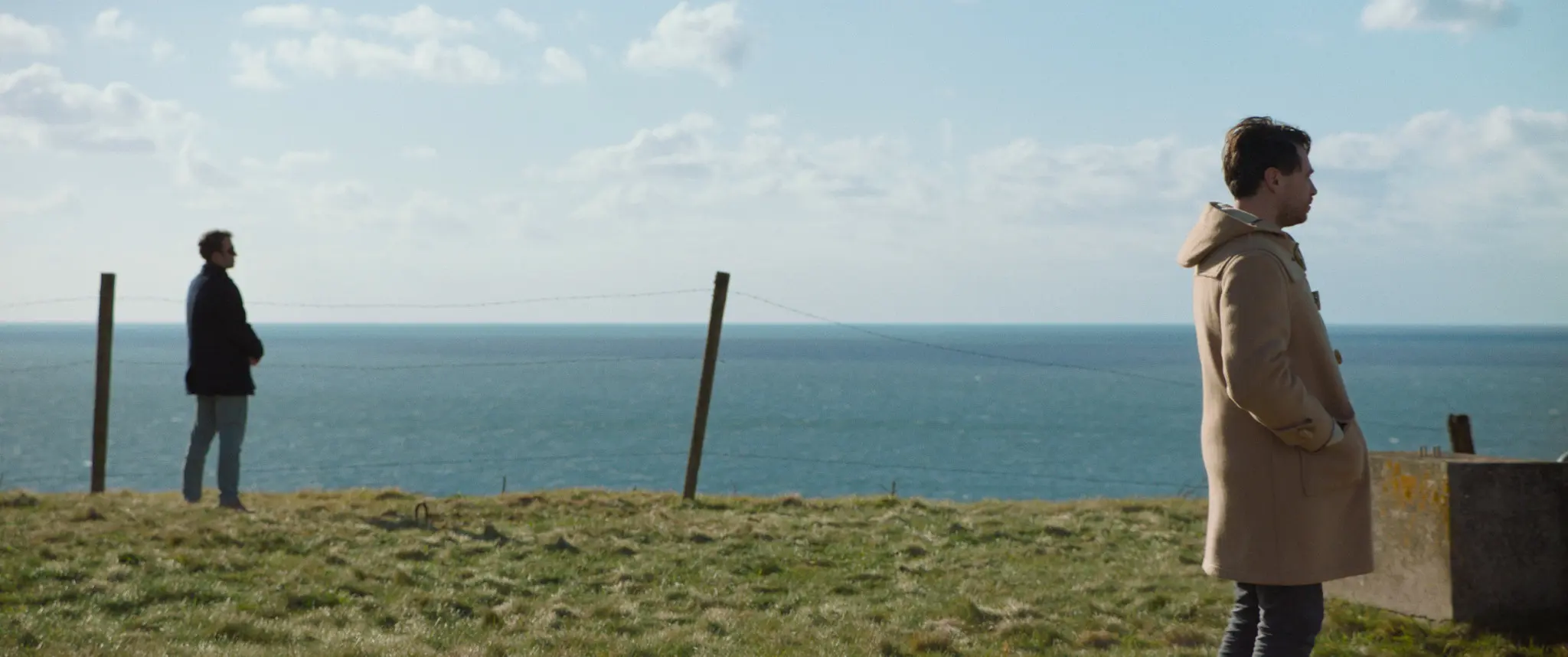
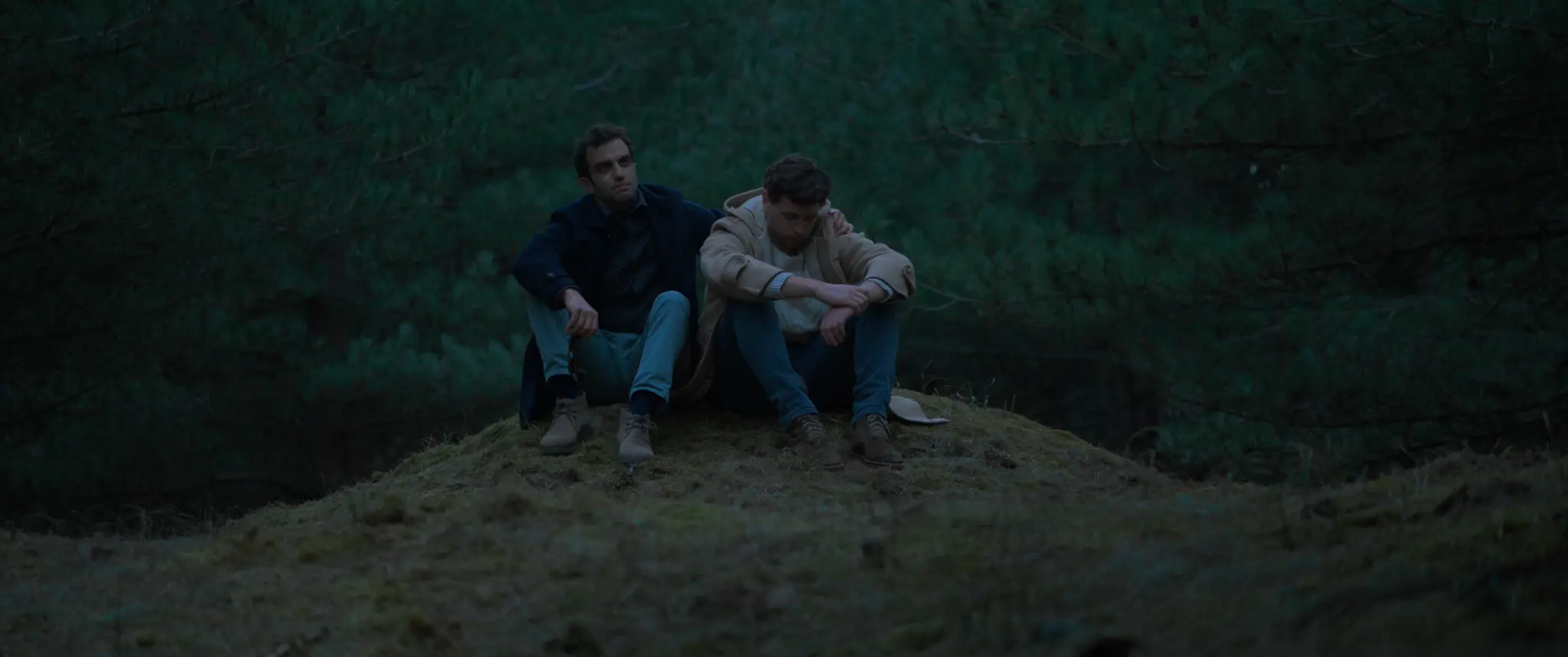
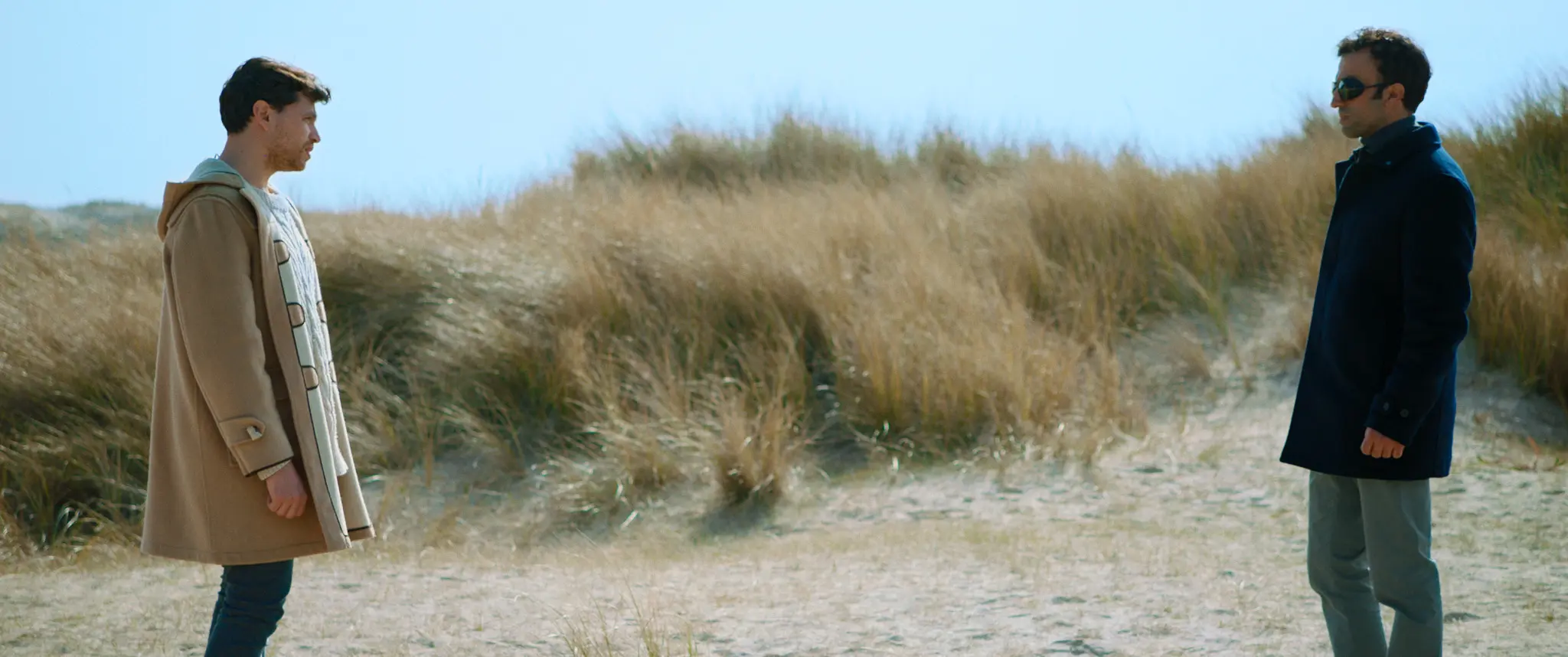
Two individuals meet on a wasteland in the middle of the countryside. They are half-brothers and have not seen each other for a long time. Both have inherited this piece of land and are about to sell it. For no apparent reason, one of them weeps. In the face of devastating grief, extreme disappointment, or more broadly when pain is so overwhelming that alone it seems impossible to overcome, the other may become a comforter.
statement
In the face of devastating grief, extreme disappointment, or more broadly when pain is so overwhelming that alone it seems impossible to overcome, the other may become a comforter.
From this encounter a fragile and precarious bond may form. A tenuous relationship built through fumbling, through clumsy attempts, and which sometimes achieves its aim: to relieve the other of some of their sorrow. If this exchange is unstable, it is because there exists no universal method, no marked path toward reaching the other's emotions. In this unmarked desert, only one proposed rule: the "law of tact 1". That is, the comforter's awareness of the need to calibrate their approach. Too physical, and it would be intrusive; too distant, and it would be perceived as indifference. Accessing the other requires a "touch", all the more complex as one must still find "the words". And how to know what to say, what to give to someone who sometimes does not yet know how to name the extent of what they have lost. It is this wavering balance that I sought to stage.
1. Jacques Derrida, Le toucher, Jean-Luc Nancy, éd. du Seuil, France, 2000
critical text
N/A
Documentary
2479 characters
N/A
2020
Mathilda Portoghese
critical text
Samuel Lecocq began with photography. But, frustrated by the polysemy of still images and drawn toward narrative, he came to realise that his practice was in fact that of video.
Deradicalisation, the Futuroscope, labour, a German bildungsroman, etc. If the subjects of his works do not appear to converge around a single theme, it is because Samuel Lecocq's practice draws its through-line from the form it takes, from a particular moment in the chronology he calls the tipping point.
The tipping point is the moment when the narrative commits to one direction and not another — where, once set straight, it becomes inescapable; it is at precisely this instant that disappointment and collapse arrive. But the tipping point is also the moment something falls, and more precisely, something that will keep on falling without stopping.
This concept of free fall, which infuses his work, Samuel Lecocq borrowed from the video artist Hito Steyerl, who theorises alongside her film In Free Fall (32 minutes, 2010) a new paradigm of the post-internet image: the era of the image seen from above, the era of vertical perspective.
Looking more closely, places are also the protagonists of Samuel Lecocq's films. Each one exerts a powerful attraction on the artist. They are always somewhat particular, charged with potential. It is in the obsession generated by his own curiosity that the filmmaker sets himself to work: by compiling documentation and images, and then, in a second stage, by going there in person and making the process of investigation the unreleased "behind-film" of his work.
Yet each of his excursions is a small disappointment in itself: the banality of his first visit to the Futuroscope (Futuristic Movie Setup), the impossibility of approaching the deradicalisation centre (Fragility and Obsolescence), the disappointment in the Czech Republic when his quest is cut short upon finding the exact setting — albeit fictional — of the book he wished to adapt (Romantic Gesture).
It is when the film takes shape, through failure and entrapment, that the artist turns it to his advantage in a final pirouette, transforming it through narrative subterfuges: a voice-off, a character speaking a foreign language, a mirror held up in nature. Samuel Lecocq circumvents and employs the mechanisms of mise en abyme and fictionalisation in order to outwit the convoluted workings of screenwriting.
Mathilda Portoghese
photographs
Haunted Media
Fiction
3 photographic objects 40×52 cm, inkjet
N/A
2020
CAC Tignous, Montreuil
Exhibition view, CAC Tignous
Exhibition view, CAC Tignous
Exhibition view, CAC Tignous
Exhibition view, CAC Tignous
1 / 4
critical text
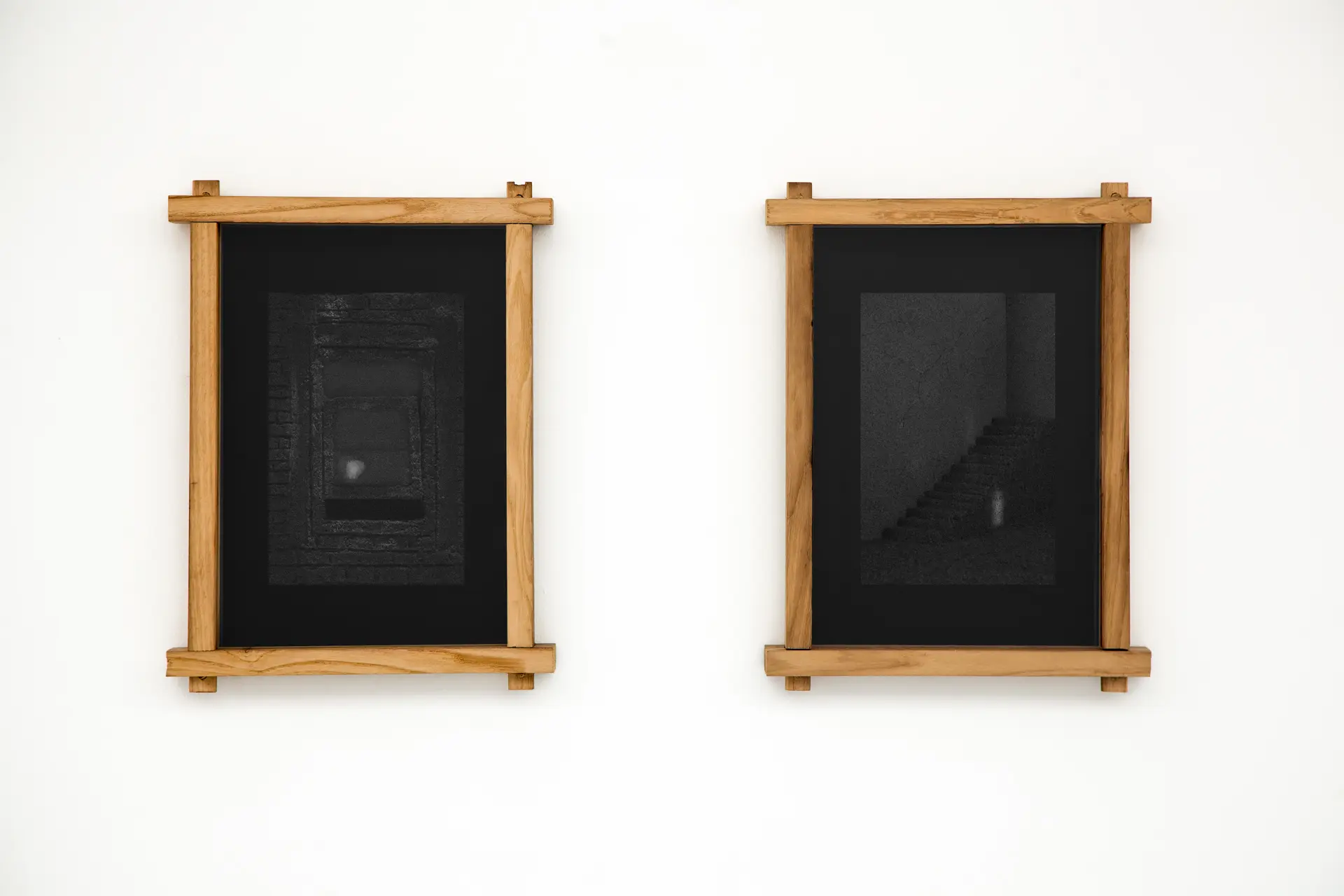
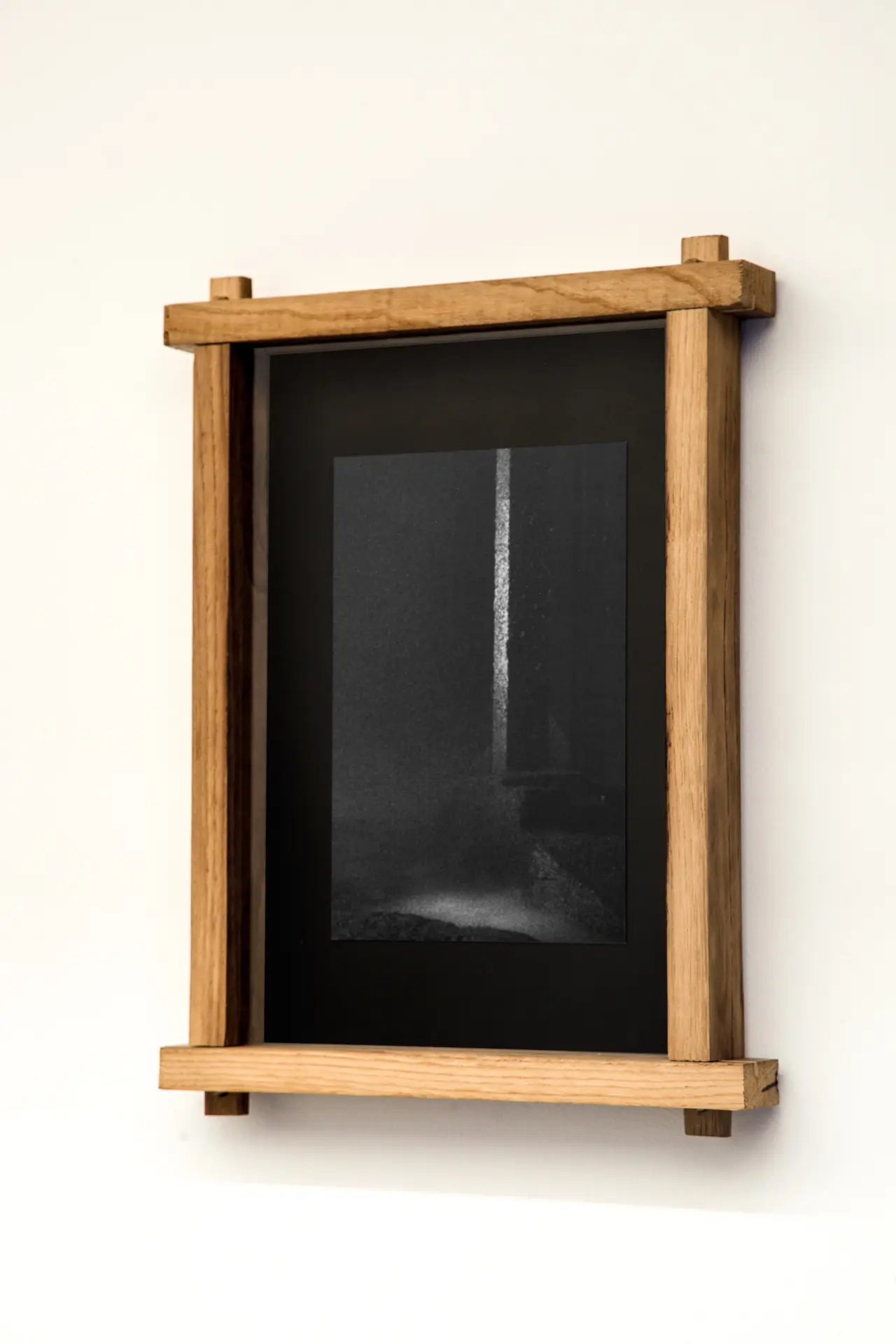
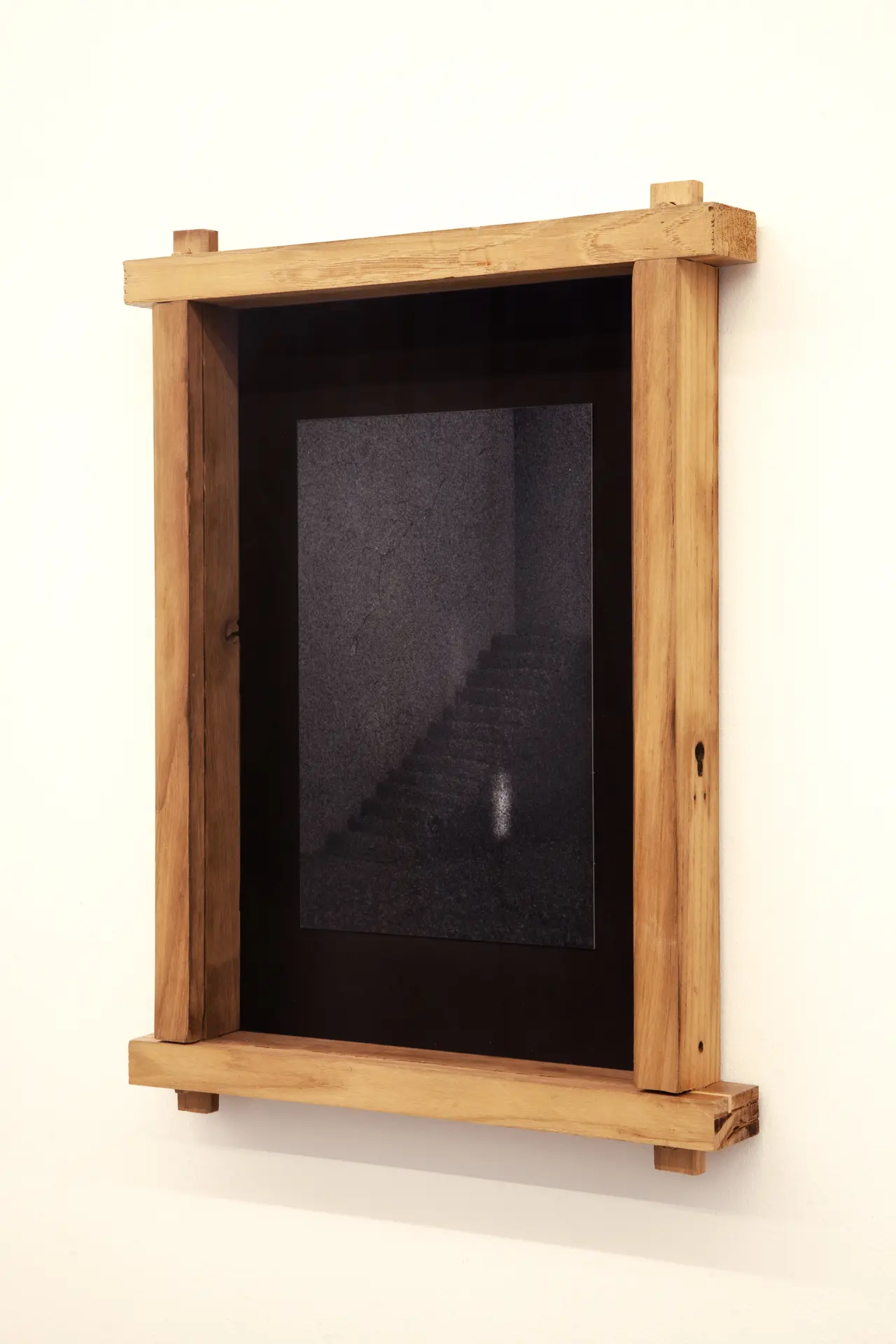
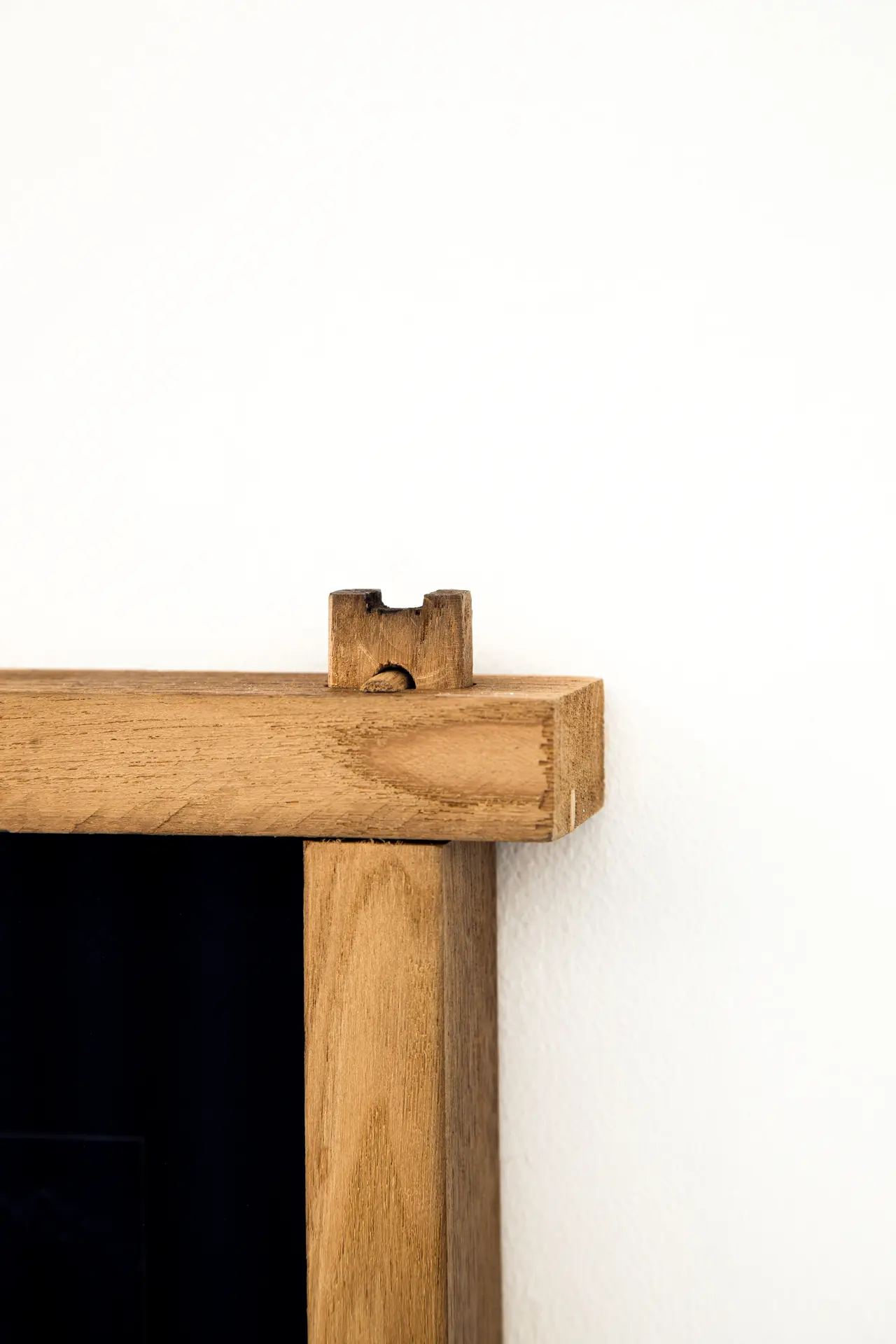
For the exhibition Sans Contact, Samuel Lecocq returns to his first love and works in tandem with his studio colleague, Brieg Huon, on a series of photographic objects. The subjects running through this series evoke the idea of a ghostly mechanism, a process deeply mysterious to our eyes, which triggers both disappearance and appearance. Perhaps the most surprising contribution is the black-and-white corpus that reprises the aesthetics of paranormal photography — a vernacular practice that hijacked physical phenomena in order to make spectres and other ghosts appear. A staircase leading nowhere, cracked walls, a column, a half-open sash window… These are in fact miniatures made of sand, whose grains merge with those of the film stock, visually recalling the snow of cathode-ray televisions. The term "photographic object" is here particularly apt, since their two interlocked practices — sculpture and image — allow for an explicit questioning of the figure-ground relationship, with a frame that is as much part of the work as the photograph itself. Variations in materials, assembly techniques and hanging methods make these frames purpose-built, establishing a genuine dialogue between image and object.
Mathilda Portoghese
notice
Black-and-white print,
pigment inkjet 20×30 cm,
mounted on aluminium.
Glass, wooden frame, 38.8×52.6 cm, d. 5 cm.
In collaboration with Brieg Huon.
synopsis
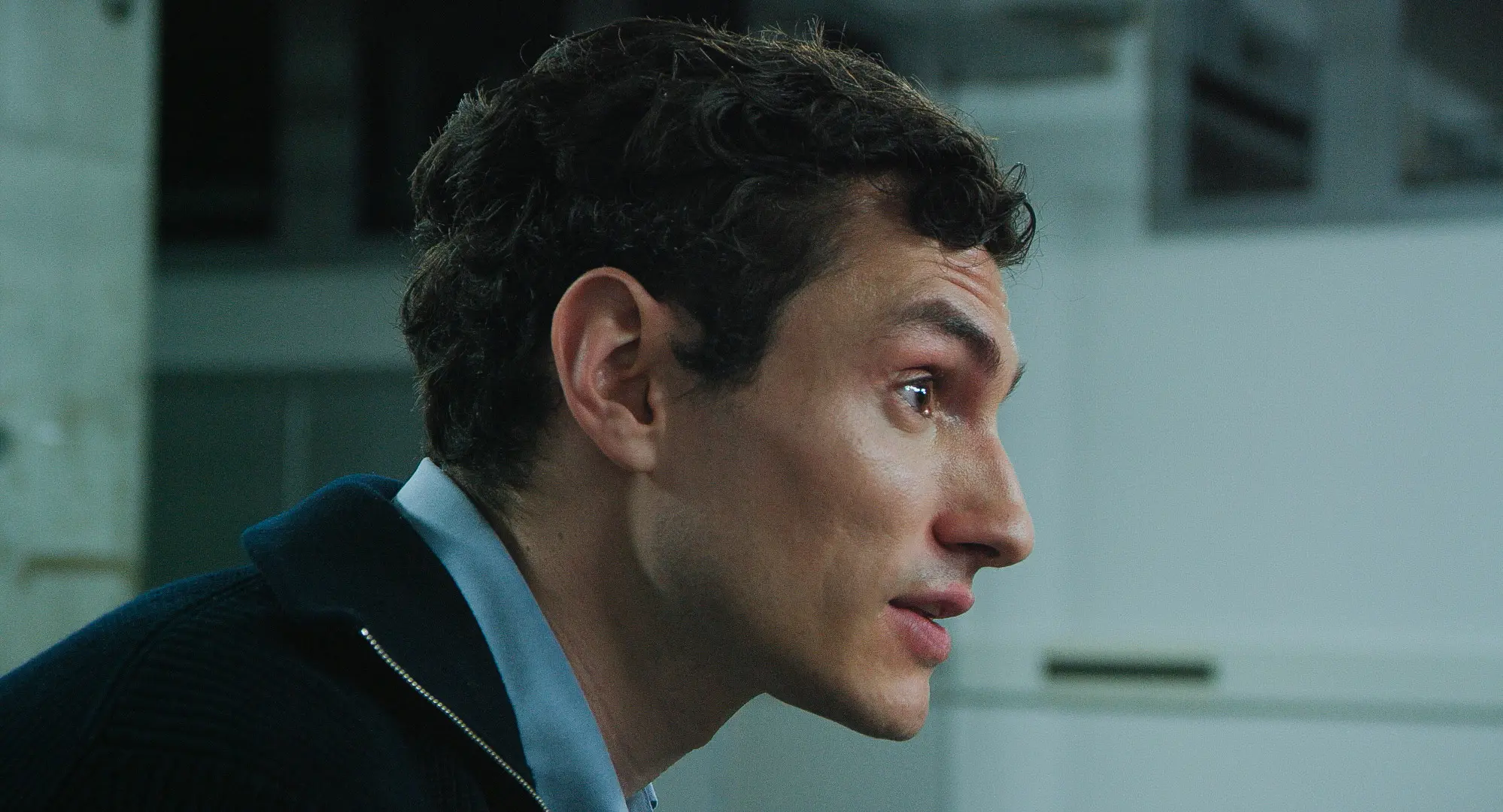
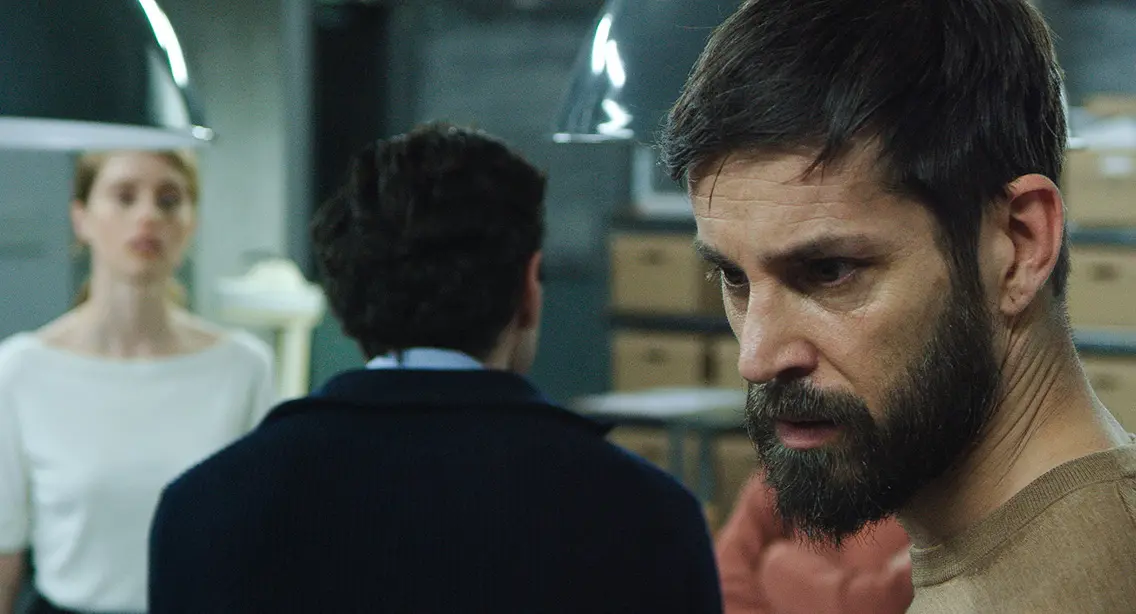
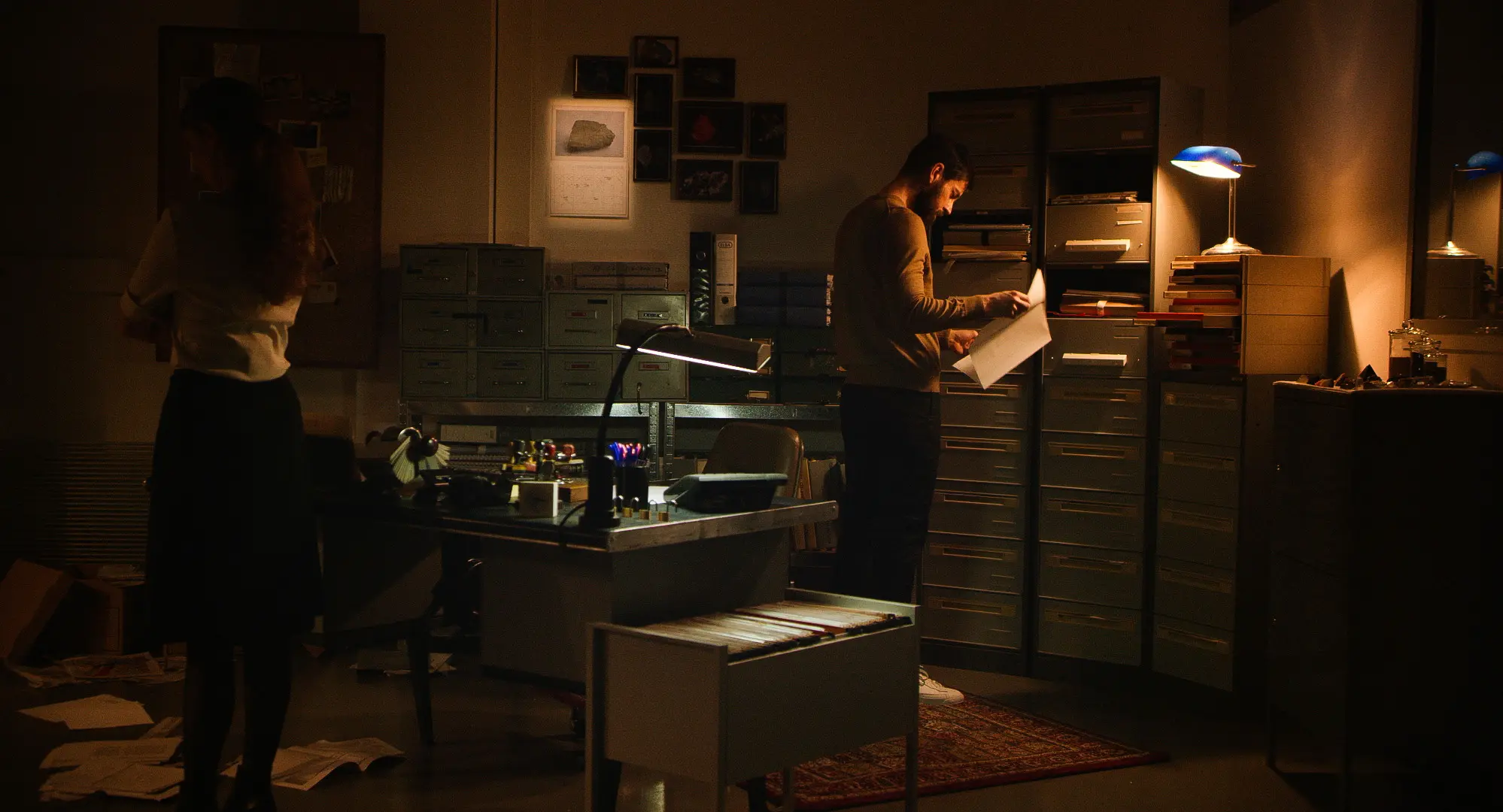
Four colleagues meet for the first time, brought together for an escape room organised by their company. From the moment they arrive, everything seems already resolved: the space is in disarray, the padlocks are unlocked, the safe is open. Uncertain of the reality of their situation, they embark on a desperate search. The film is built on an initial premise: the space in which the protagonists find themselves is a post-apocalyptic environment.
statement
The film is built on an initial premise: the space in which the protagonists find themselves is a post-apocalyptic environment. An escape room already played, already completed, depleted of its narrative substance — where objects are worn out, useless, where puzzles have already been solved — becomes a metaphor for a world after the end. A world without hope, without consolation, in which one confronts the disappearance of meaning. This fictional premise structures the rest of the film: how does the fictional experience of the end of the world nourish contemporary critical thought?
Moreover, each of the four characters — an employee of a large corporation — has undergone, at some point in their professional life, an experience of alienation, conscious or otherwise. A hold, a conditioning, a denial of reality; each brings their own individual disorder. I have for some time been interested in forms of revolt linked to skilled, comfortable jobs that nonetheless fail to satisfy. Jobs that participate in the invention of new afflictions, such as "brownout" (the loss of meaning in one's work).
Finally, this film also addresses the question of the "body". First, the bodies of the characters: forgotten and neglected within their professional environment. "Taking care" of one's body becomes a necessity — or, conversely, a source of guilt when they renounce it. These bodies will evolve throughout the film and progressively transform into language. Gesture, movement, posture, bearing become the means of new communication between the protagonists. The body is also engaged in its figurative sense: the social body, the one that forms the group, the community.
video
Le jeu de la Fugue, I, II, III, IV
Experimental
1920×1440, 4/3
18
2019
Self-produced
still, le jeu de la Fugue, I, II, III, IV, 1440×1080
still, le jeu de la Fugue, I, II, III, IV, 1440×1080
still, le jeu de la Fugue, I, II, III, IV, 1440×1080
still, le jeu de la Fugue, I, II, III, IV, 1440×1080
still, le jeu de la Fugue, I, II, III, IV, 1440×1080
still, le jeu de la Fugue, I, II, III, IV, 1440×1080
statement
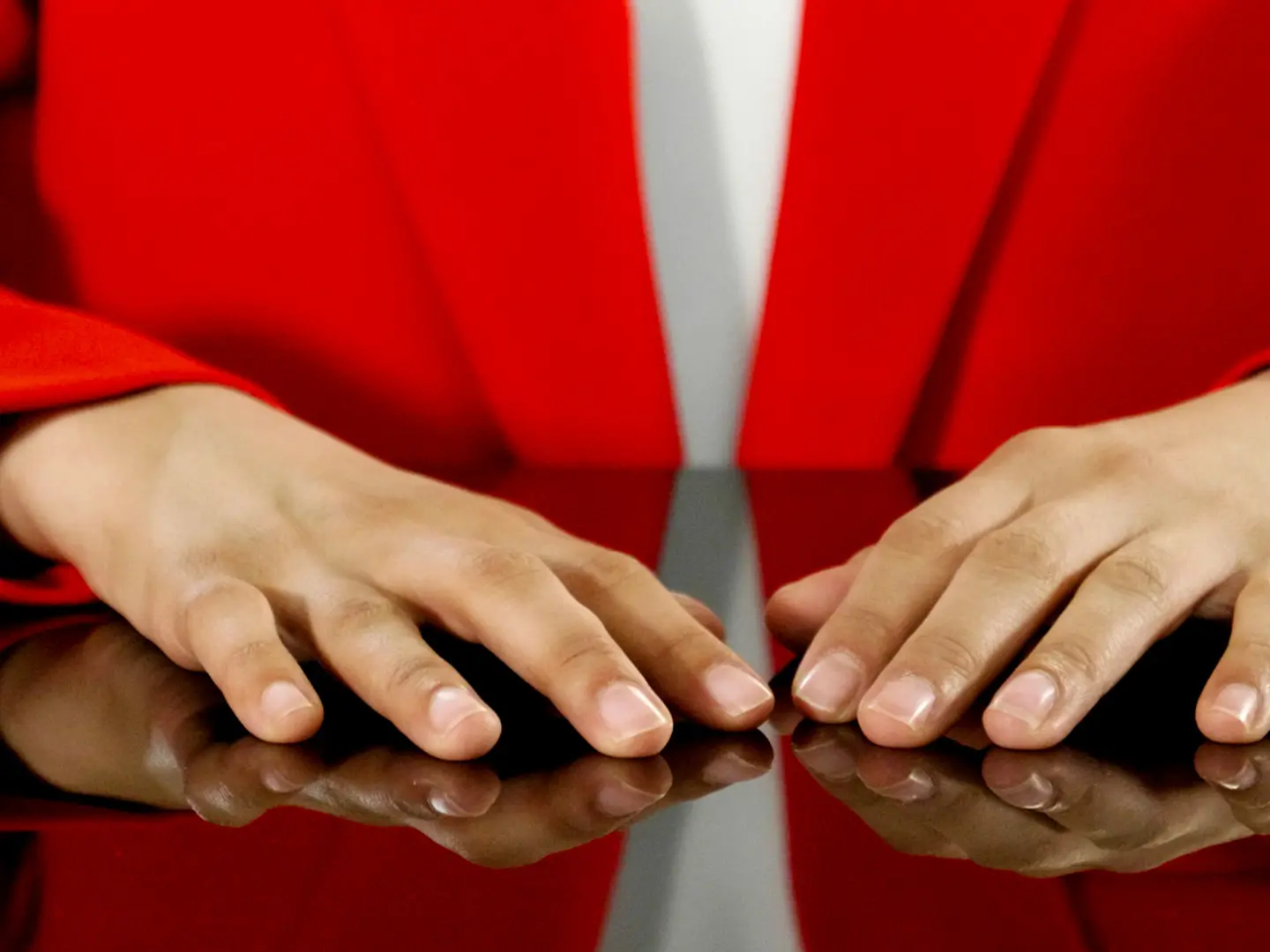
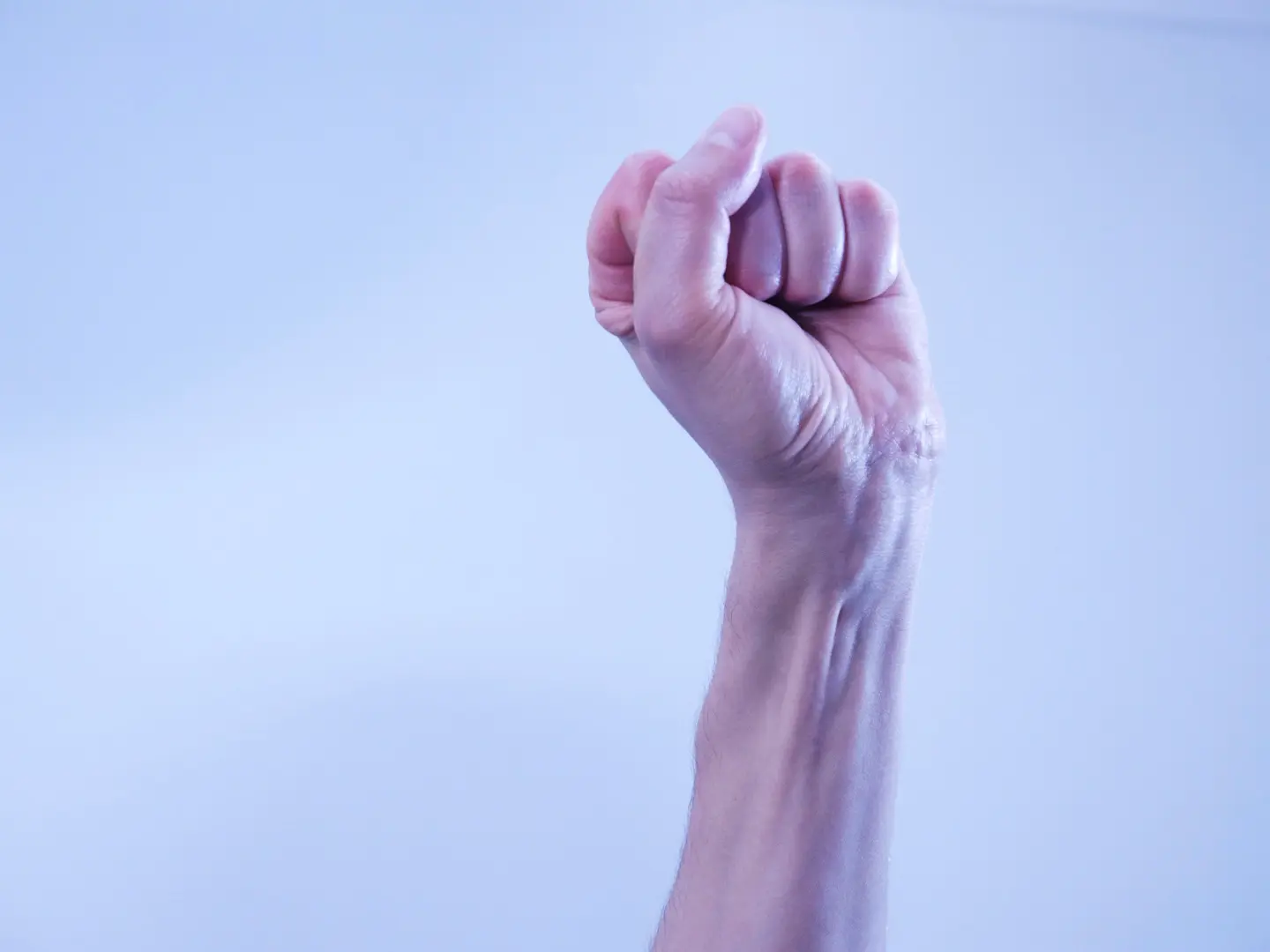
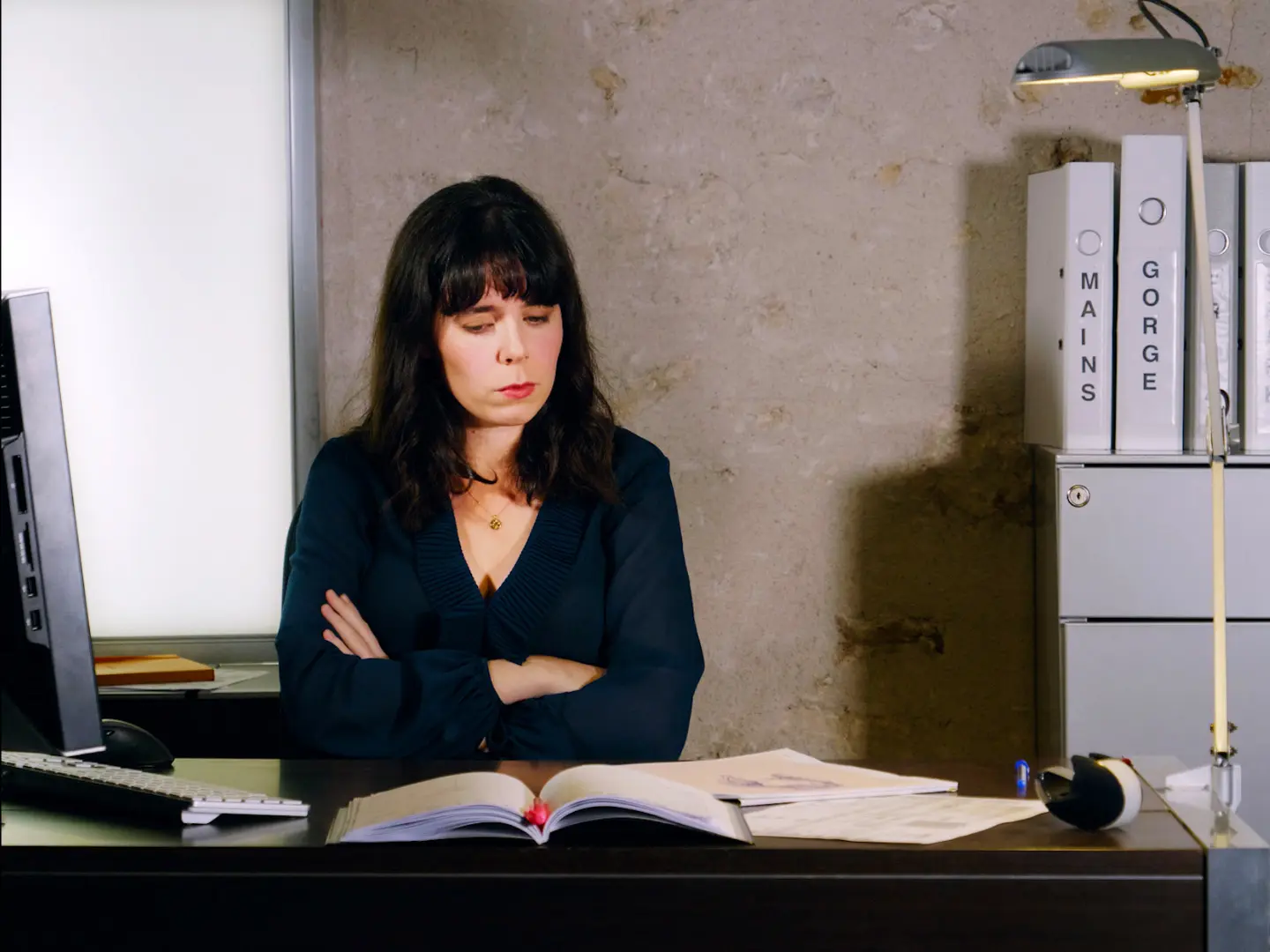
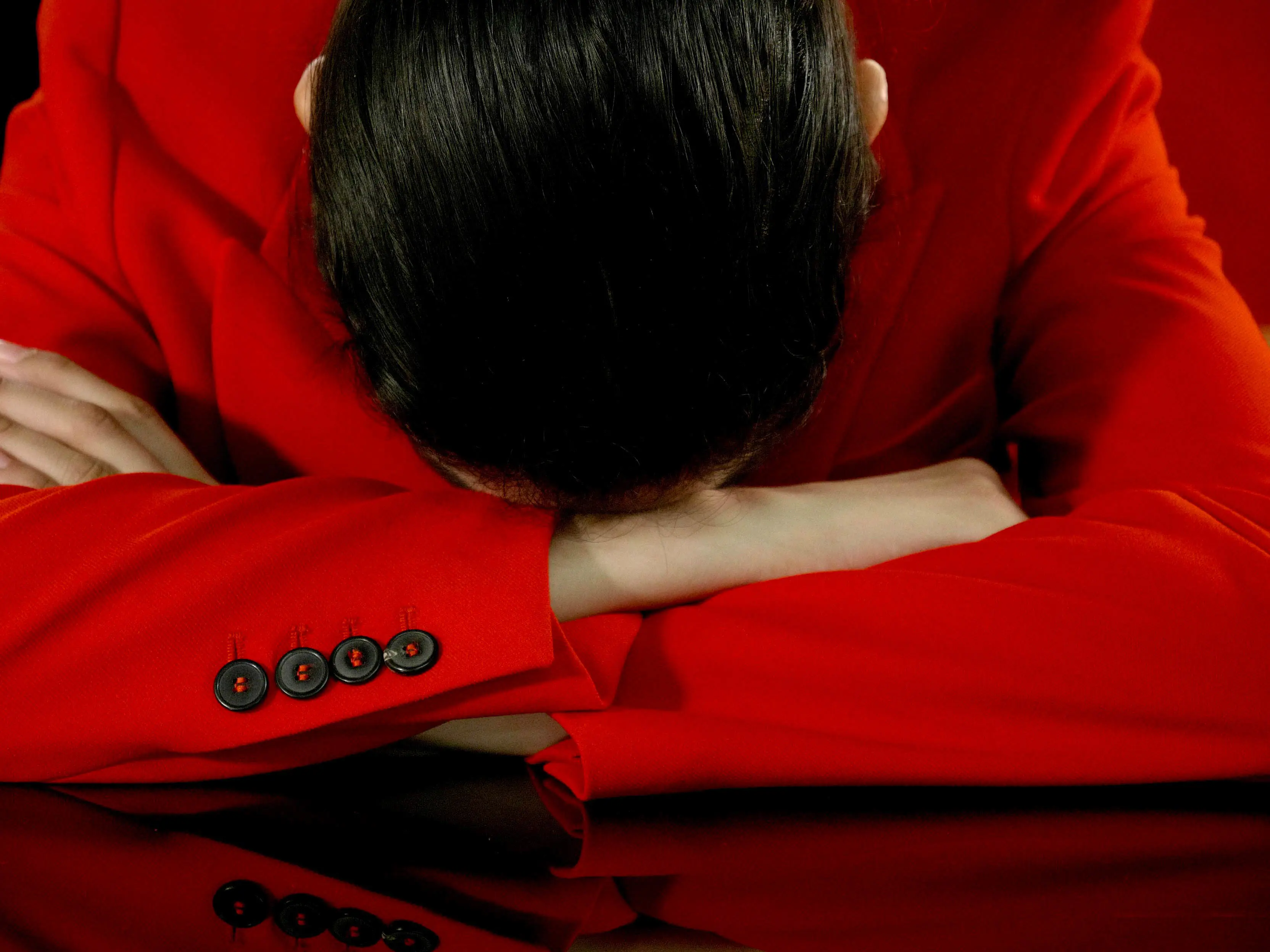
The fugue as a flight from which one knows one will return. Like a game where one pretends to escape, only to ultimately reintegrate everyday life. A fantasised revolt, without consequence. Four characters escape without taking any risk, within the rhythm of a life orchestrated by work. This video is a succession of portraits: alone before the camera, the protagonists stage the account of their "fugue" — in other words, the account of their revolt, repressed within their alienating professional environment, which is released and unfolds in their autofiction.
synopsis
Hélène is an engineer; she produces fragments of sorting robots without really understanding what they slot into or where they end up. Hypolite spends his time writing accounting booklets which in most cases are destined for archiving and ultimately destroyed. He knows, however, that if a succession of rare coincidences were to destabilise the company, only his booklet would allow it to survive. Mathilde is an usher in a large theatre, where at the slightest mistake customers demand to speak to a manager. Finally, Patrick is the exception: his work does not trouble him. His personal fulfilment is concentrated in the gym, where for the first time he has managed to find the ideal sequence of exercises minimising soreness and muscular fatigue.
critical text
N/A
Documentary
1357 characters
N/A
2018
Matthieu Lelièvre
critical text
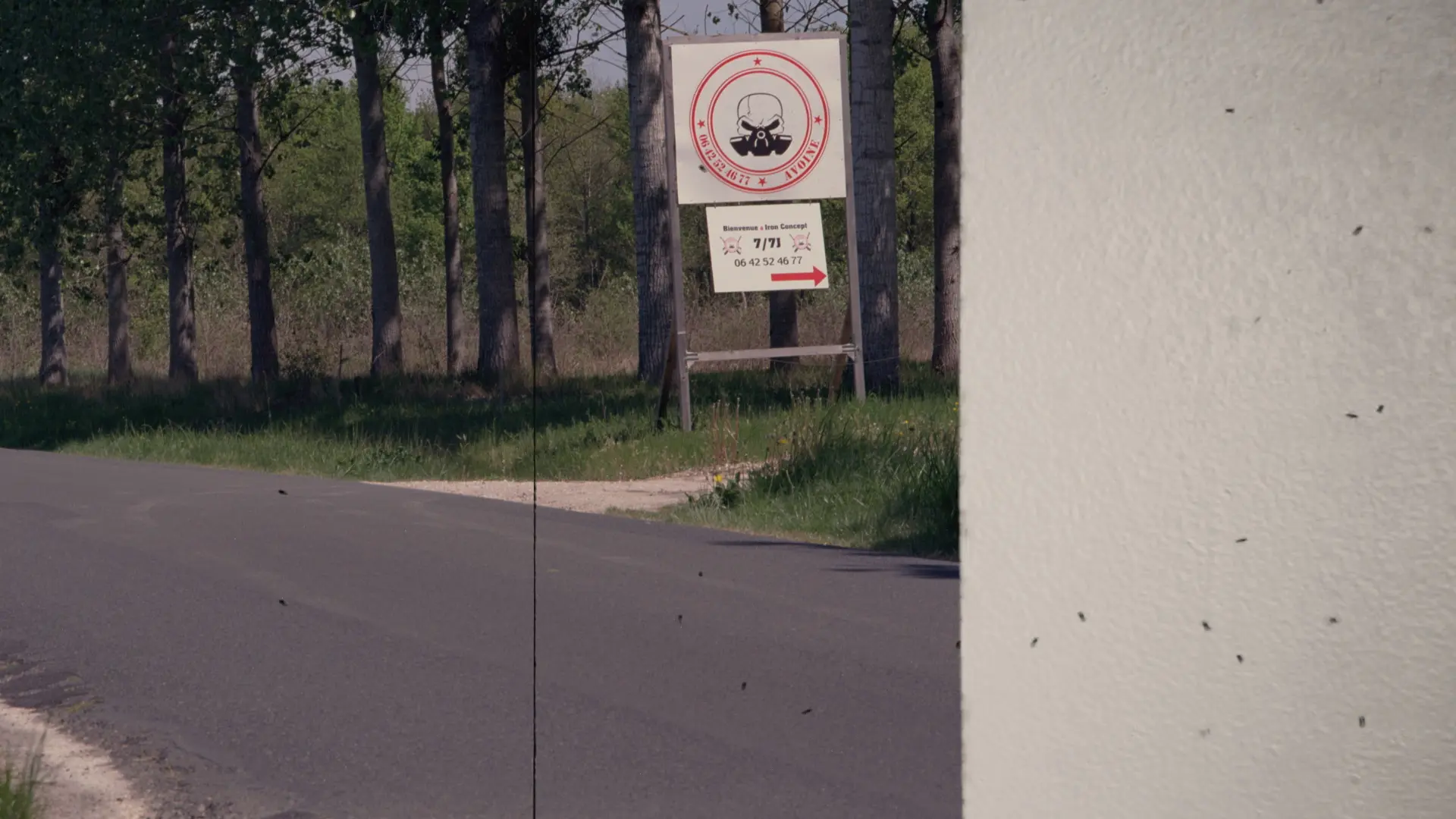
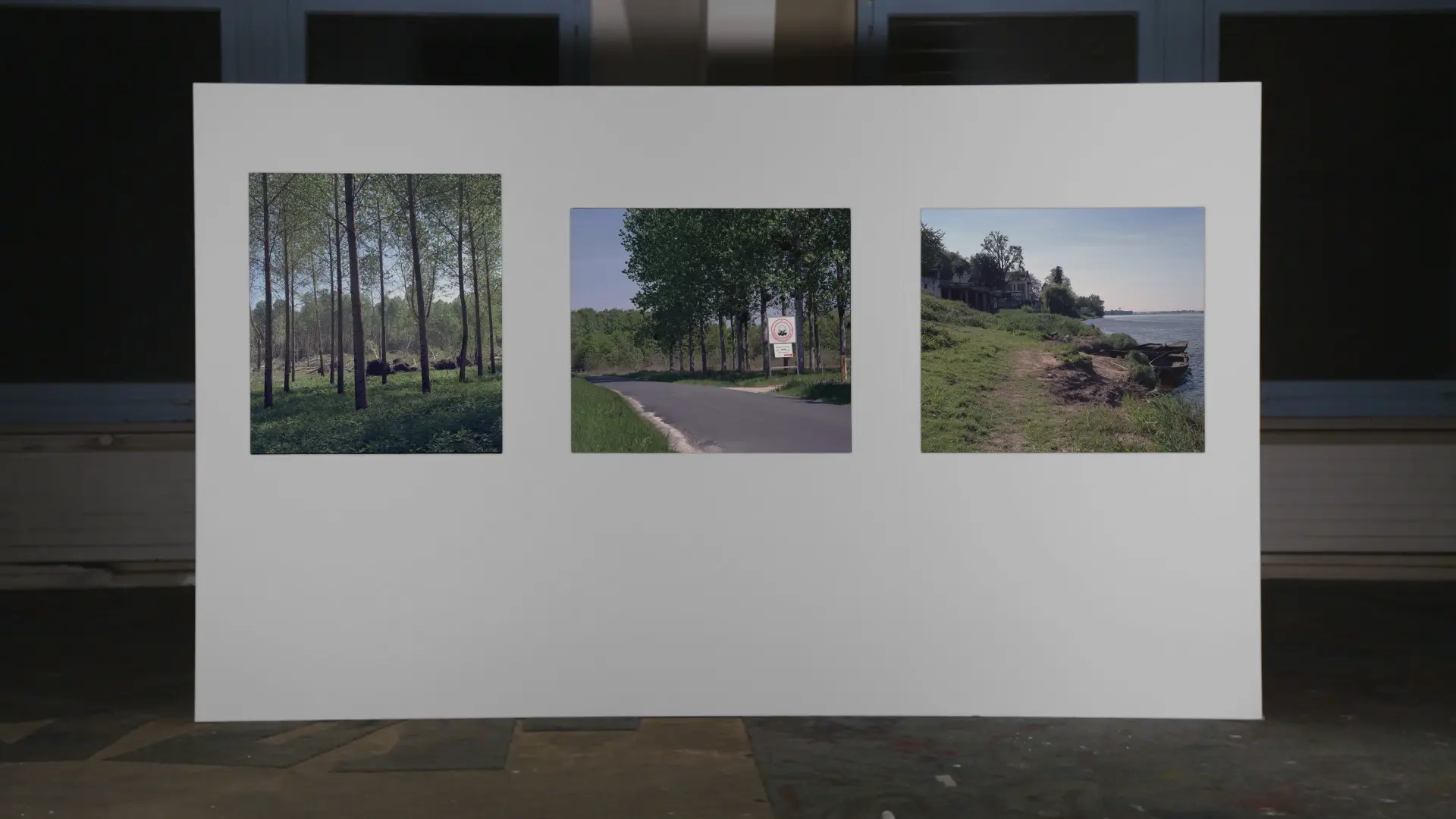
A particular relationship binds photography to the filmed image in Samuel Lecocq's work. His narratives are conceived as a multitude of juxtapositions. Fragments communicate in non-linear ways to constitute a story with a sensibly off-axis narration, and the relationship to installation is not foreign to the construction of the narrative. The artist wants to "put subjects into crisis" and is deeply interested in the way the viewer mentally reconstitutes this account. Structured as chapters, the story of Fragility and Obsolescence progresses slowly. The voice-off — whose narrator is a photographer — evokes the desire to know what is hidden and the difficulty of piercing what comes to conceal information and knowledge. Photographs arranged as on an exhibition wall or a floating digital presentation alternate with slow captures of bocage landscapes in apparent disconnect from the violence of the subject.
The image seemingly distances us from the argument while the anxiety induced by decomposition and the slow movement of the camera ascending a calm, shallow river — where everything looks the same — imposes on the viewer a symbolic and philosophical reading of the narrative: these images are ghost images, they are too problematic, the voice tells us... The argument then leads us around the subject as if to allow us to reach an essential and surprising angle.
In this singular video exploring a "deradicalisation" centre, Samuel Lecocq's mode of operation sits at the boundary of documentary reportage. He composes an approach that challenges the forms of bias and recuperation of such a sensitive subject at the heart of societal and political debates, while balancing objectivity and subjectivity. By engaging with this question of rare tension, his film attempts — without idealising or interfering — to renew the forms of narration, between film and documentary, as an extension of certain of Godard's investigations. His works embrace the mixing of genres and are built on this brutal confrontation, moving from sculpture to video while preserving that constant sensitivity to photography, omnipresent in his work. He exploits the image in all its forms and turns to documentary and animation while mixing formats, playing at once with conventions of space and time.
synopsis
A young actor, alone in a closed space, expresses his rage. He has just taken part in the filming of a movie — the cinematic adaptation of a 19th-century romantic novel. In a monologue in which rational argument gives way to emotional appropriation, he rails against the final result, the film's failure to convey the complexity of the literary work. Der Hagestolz (The Bachelor) is a romantic bildungsroman (1844) by the Austrian author Adalbert Stifter.
statement
This video is an adaptation of a romantic novella by Adalbert Stifter, "The Bachelor". Before beginning production, I wanted to internalise this story in order to render as faithfully as possible the intensity and concision of the text. However many drafts I wrote, however many trips I made "in the footsteps" of the author, however many faithful or abstract staging attempts I made, nothing I did seemed capable of capturing the complexity of the text. It was through staging my own research experience that a way into the subject revealed itself. I therefore composed the video around a single character. A young actor, in a closed space, expressing his rage. He recounts his involvement in a cinematic adaptation of a 19th-century romantic novel. In a monologue in which rational argument gives way to emotional appropriation, he rails against the final result. In my adaptation, the "mood landscapes", the lyrical and restrained writing, the obsession with detail so characteristic of the work are not rendered as images, but evoked in the passionate words of a young man. The set design, decor and costumes participate in suggesting the original work.
statement
In September 2016, the centre for prevention, integration and citizenship (CIPC) opened its doors. It was designated as the first French "deradicalisation" centre. Its resources, organisation and very existence were constantly debated. Access was restricted, its surroundings hyper-secured, inaccessible to journalists — let alone artists. This video is the account of an attempt at apprehension: the construction of a narrative strategy aimed at generating a representation of this physical, aesthetic and philosophical territory. Marie-José Mondzain, in her essay "Confiscation", proposes a reappropriation of the divisive term "deradicalise". Once extracted from its reductive definition (reversing an extremist belief), it becomes a means of revealing fragility and obsolescence in the real. It is from this conceptual premise that the video is organised, edited and realised.
statement
The Futuroscope is a futuristic theme park built in the early 1980s in France near Poitiers. It was dedicated to new technologies enabling the display and diffusion of the image. Embedded in its foundations, a profession of faith bears witness to the humanist ambitions of its architect, Denis Laming. This hybrid video intersects the formats of the trailer, the documentary and the short film. Different types of images interweave: archive footage of the site's creation, CGI compositions, the making-of of a potential film. The narrative proposes an alternative, fragmentary and fictional version of the park — a uchronic vision: Futuropolis. Between appropriation and détournement of science-fiction film codes, this essay is also an opportunity to give form to questions inherent to the image itself: its capacity to trap, to testify, to falsify itself.